Showing: 1 - 10 of 10 Articles
Major Arcana–inspired tarot cards arranged on dark velvet cloth, lit dramatically with gold highlights and cool blue tones, suggesting a contemplative spiritual gateway.

What Is Tarot Symbolism in Theosophical Philosophy (and How Does It Work)?

Tarot symbolism in Theosophical philosophy refers to the interpretation of Tarot cards as a visual compendium of universal spiritual truths, cosmic laws, and the soul’s journey through levels of consciousness rather than a mere divination tool. In this framework, each card becomes a meditation gateway, its imagery encoding principles from The basics of Theosophy such as karma, reincarnation, the seven planes of existence, and the hidden structure of the cosmos.
While many approach Tarot as a fortune-telling device, Theosophists since the late 19th century have recognized the deck as a deeply philosophical system. Figures like …

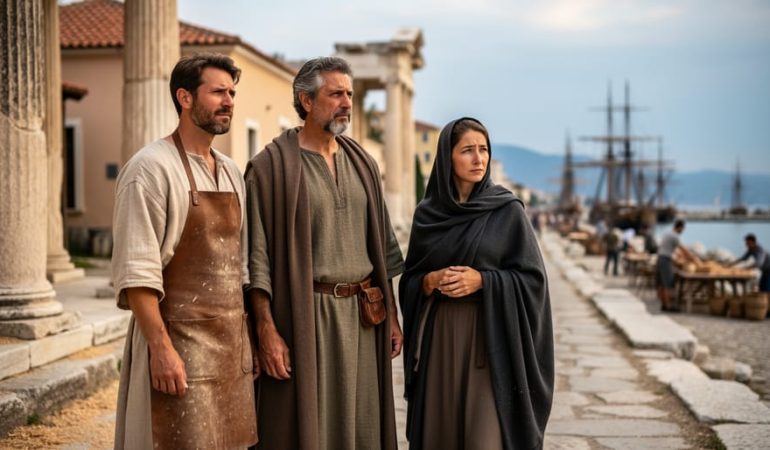
Early Christians in ancient Thessalonica standing together in a reflective moment, with blurred harbor activity in the background.

1 Thessalonians Context: Reading Paul’s Letter Through a Theosophical Lens

Paul’s first letter to the Thessalonians emerged around 50-51 CE from Corinth, making it one of the earliest Christian documents we possess and a raw snapshot of a fledgling spiritual community wrestling with profound questions about faith, mortality, and cosmic transformation. The apostle wrote to believers in Thessalonica (modern Thessaloniki, Greece) only months after founding their assembly, responding to persecution they faced and confusion about loved ones who had died before Christ’s expected return.
Understanding this context unlocks far more than historical trivia. It reveals universal patterns that echo through…

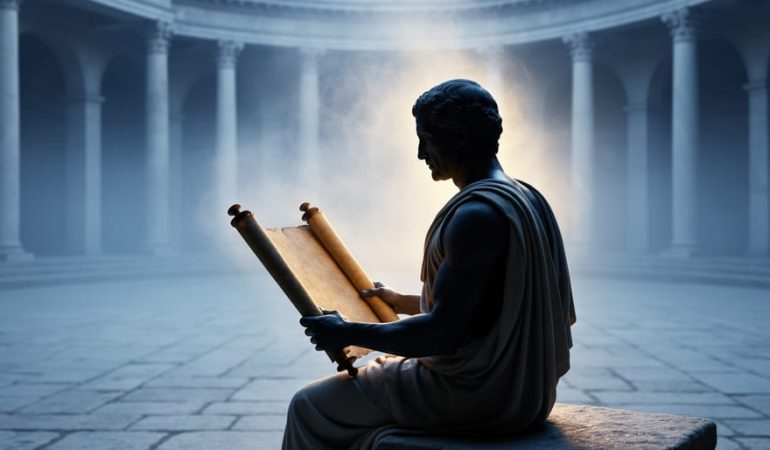
A contemplative ancient Greek philosopher-like figure seated with a scroll in a classical courtyard as a faint luminous glow rises behind him.

How Plato’s Philosophy Shaped the Foundation of Theosophical Thought

Twenty-four centuries after his death, Plato stands as one of the most influential thinkers in human history, his ideas forming the bedrock of Western philosophy and resonating deeply within spiritual traditions worldwide. His contributions extend far beyond academic philosophy. They touch the very questions that drive seekers across cultures: What is real? How should we live? What happens to the soul after death?
Born around 428 BCE in Athens, Plato founded the Academy and developed a philosophical system that would shape everything from Christian theology to Islamic mysticism to modern theosophy. His student Aristotle went on to …

Diverse adults seated around a round table in a warm sunlit library, with open books, a brass compass, a small Buddha figurine, and a microscope on the table, and an unlabeled globe and star mural softly blurred in the background.

How the Theosophical Society in America Shaped a Worldwide Movement

In the landscape of spiritual seeking, few organizations have shaped Western esoteric thought as profoundly as the Theosophical Society in America. Founded in 1875 in New York City by Helena Petrovna Blavatsky, Henry Steel Olcott, and William Quan Judge, this pioneering movement emerged at a remarkable crossroads of science, religion, and philosophy, offering seekers an alternative to both rigid materialism and dogmatic faith.
The Theosophical Society in America stands as the primary American branch of a global network dedicated to exploring the hidden dimensions of existence. While theosophical organizations exist worldwide, TSA …

Over-the-shoulder view of a person at a laptop with blue screen glow showing abstract gambling icons, a candle and small lotus statue on the desk, and a softly blurred bookshelf and night skyline in the background.

When the Gamble Isn’t Worth Your Soul: A Theosophical Look at Online Betting

The digital age presents us with unprecedented choices, and online gambling platforms—where real time dealers on casino platforms facilitate countless transactions daily—raise profound questions for those walking a spiritual path. How do theosophical principles guide us through this modern landscape where consciousness, desire, and consequence intersect in virtual spaces?
Theosophy teaches that every action ripples through the fabric of karma, that our choices shape not only our immediate circumstances but our soul’s evolutionary …

Brass incense burner emitting smoke next to an unlabeled dark-glass vape cartridge, mala beads, and a closed antique book on a wooden table, with warm sunlight and blurred plants and a lattice window in the background.

When Ancient Wisdom Meets Modern Cannabis: A Theosophical Perspective on Delta-9 THC

Consider how ancient wisdom traditions meet modern consciousness exploration—an unlikely intersection that challenges our assumptions about spirituality and substance. Theosophy, the 19th-century philosophical movement founded by Helena Blavatsky, proposed universal truths underlying all religions and advocated disciplined spiritual development through meditation, ethical living, and expanded awareness. Today, Delta-9 THC vape cartridges represent a contemporary method of altering consciousness, raising provocative questions: Would theosophists view cannabis as a spiritual tool or a distraction from …

Spiritual Awakening Through Vaping?

Vaping can have a calming effect on the mind. It could also lead you along a road of spiritual development. Keep reading to know more about how vaping e-juice could help you relax and maybe help you reach spiritual enlightenment.
Having a Genuine Spiritual Awakening
Many people are curious about spiritual awakening. It’s difficult to say whether you’ve ever had a similar experience. Every person’s journey is unique, however, there are a few common spiritual awakening signs.

The True Meaning of Karma

From being a foreign concept, Karma became mainstream in the west when the Theosophical Movement and Madame Blavatsky introduced it. People saw the truth of Karma and embraced it in their spiritual lives.
Not everyone gets the true notion of the Law of Karma; this spiritual teaching has often been misunderstood.
Law of Karma
Karma is the Law of Cause and Effect, Sequence and Consequence, and Action and Reaction. This law teaches us that an effect comes back to you in everything you do, as this is the universe’s way to balance and harmonize everything and everyone in it.
You are subject to …

The Theosophical Movement

The difference between the theosophical movement and the theosophical society is that the former has the universal, spiritual, ethical, and moral continuous effect that will last a lifetime.
On the other hand, the theosophical society is formed by organizations and bodies made by men. These organizations may have different participants from time to time, especially when alterations happen and men stick to dogmatism.
The theosophical movement has all the freedom compared to the theosophical societies. You can see its teachings being spread to nations for centuries. These movements welcome spiritual ideas no matter how they are…

The Basics of Theosophy

Theosophy does not propose a single principle as this varies in religion. Therefore, you will see differences in insights and practices from different authors.
Because of these loud contradictions, students are divided as they choose the author they believe in, and they create feuds with whoever opposes their beliefs. Theosophy aims to unite, not divide.
Therefore, the theosophy’s culture has developed over the years is not what it always wanted as it now creates dogma. Theosophy is about being open-minded about the different beliefs there are, as it knows that humans can own ideas that differ from others’ all the time….