Showing: 1 - 4 of 4 Articles
Major Arcana–inspired tarot cards arranged on dark velvet cloth, lit dramatically with gold highlights and cool blue tones, suggesting a contemplative spiritual gateway.

What Is Tarot Symbolism in Theosophical Philosophy (and How Does It Work)?

Tarot symbolism in Theosophical philosophy refers to the interpretation of Tarot cards as a visual compendium of universal spiritual truths, cosmic laws, and the soul’s journey through levels of consciousness rather than a mere divination tool. In this framework, each card becomes a meditation gateway, its imagery encoding principles from The basics of Theosophy such as karma, reincarnation, the seven planes of existence, and the hidden structure of the cosmos.
While many approach Tarot as a fortune-telling device, Theosophists since the late 19th century have recognized the deck as a deeply philosophical system. Figures like …

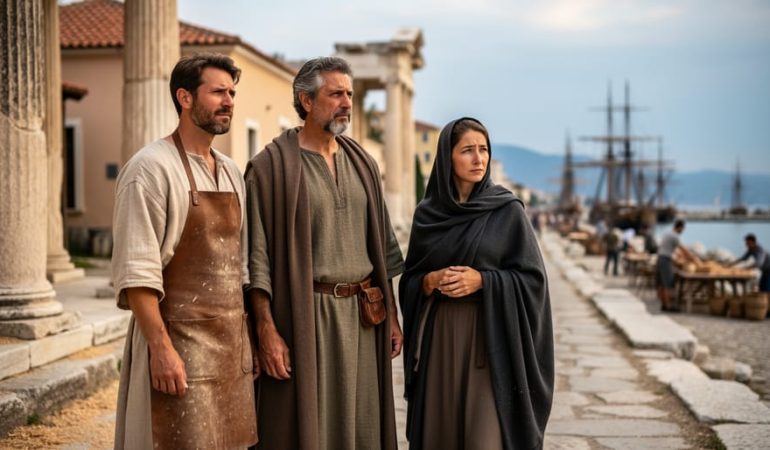
Early Christians in ancient Thessalonica standing together in a reflective moment, with blurred harbor activity in the background.

1 Thessalonians Context: Reading Paul’s Letter Through a Theosophical Lens

Paul’s first letter to the Thessalonians emerged around 50-51 CE from Corinth, making it one of the earliest Christian documents we possess and a raw snapshot of a fledgling spiritual community wrestling with profound questions about faith, mortality, and cosmic transformation. The apostle wrote to believers in Thessalonica (modern Thessaloniki, Greece) only months after founding their assembly, responding to persecution they faced and confusion about loved ones who had died before Christ’s expected return.
Understanding this context unlocks far more than historical trivia. It reveals universal patterns that echo through…

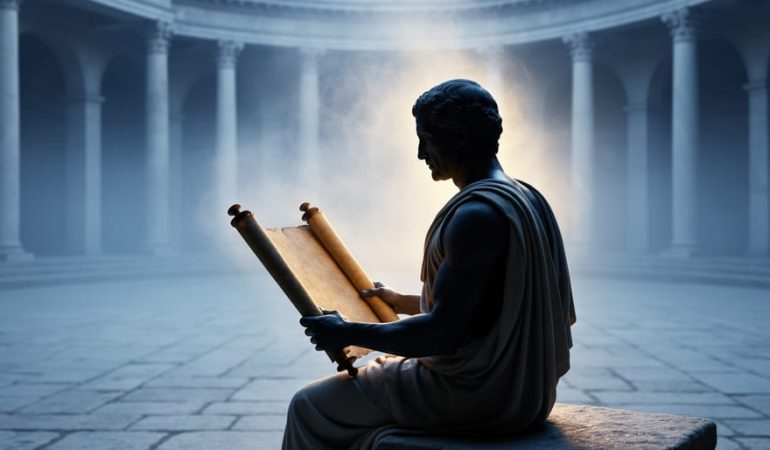
A contemplative ancient Greek philosopher-like figure seated with a scroll in a classical courtyard as a faint luminous glow rises behind him.

How Plato’s Philosophy Shaped the Foundation of Theosophical Thought

Twenty-four centuries after his death, Plato stands as one of the most influential thinkers in human history, his ideas forming the bedrock of Western philosophy and resonating deeply within spiritual traditions worldwide. His contributions extend far beyond academic philosophy. They touch the very questions that drive seekers across cultures: What is real? How should we live? What happens to the soul after death?
Born around 428 BCE in Athens, Plato founded the Academy and developed a philosophical system that would shape everything from Christian theology to Islamic mysticism to modern theosophy. His student Aristotle went on to …

Diverse adults seated around a round table in a warm sunlit library, with open books, a brass compass, a small Buddha figurine, and a microscope on the table, and an unlabeled globe and star mural softly blurred in the background.

How the Theosophical Society in America Shaped a Worldwide Movement

In the landscape of spiritual seeking, few organizations have shaped Western esoteric thought as profoundly as the Theosophical Society in America. Founded in 1875 in New York City by Helena Petrovna Blavatsky, Henry Steel Olcott, and William Quan Judge, this pioneering movement emerged at a remarkable crossroads of science, religion, and philosophy, offering seekers an alternative to both rigid materialism and dogmatic faith.
The Theosophical Society in America stands as the primary American branch of a global network dedicated to exploring the hidden dimensions of existence. While theosophical organizations exist worldwide, TSA …