melissa
 Tarot symbolism in Theosophical philosophy refers to the interpretation of Tarot cards as a visual compendium of universal spiritual truths, cosmic laws, and the soul’s journey through levels of consciousness rather than a mere divination tool. In this framework, each card becomes a meditation gateway, its imagery encoding principles from The basics of Theosophy such as karma, reincarnation, the seven planes of existence, and the hidden structure of the cosmos.
While many approach Tarot as a fortune-telling device, Theosophists since the late 19th century have recognized the deck as a deeply philosophical system. Figures like P.D. Ouspensky and Manly P. Hall saw the Major Arcana’s 22 cards as corresponding to stages of spiritual initiation, the Minor Arcana reflecting elemental forces and psychological states. This wasn’t accidental symbolism but deliberate encoding, a visual alphabet for those studying ancient wisdom traditions.
What makes the Theosophical lens distinctive is its insistence that Tarot mirrors the structure of reality itself. The cards aren’t just pretty pictures or psychological archetypes. They’re maps of consciousness, reflecting the three-fold nature of existence (spirit, soul, body), the interplay of divine and material forces, and humanity’s potential evolution toward enlightenment. Understanding this connection opens Tarot to contemplative study rather than predictive guesswork.
This article breaks down how Theosophical philosophy interprets Tarot’s symbolic language, what each layer of the deck represents within cosmic law, and how practitioners use the cards as tools for inner development. Whether you’re new to either tradition or seeking to deepen your practice, you’ll discover a framework that transforms 78 cards into a complete spiritual curriculum through resources like Cariabella Esoterics which offers guidance for those exploring these interconnected wisdom traditions.
What Tarot Symbolism Means in Theosophical Thought
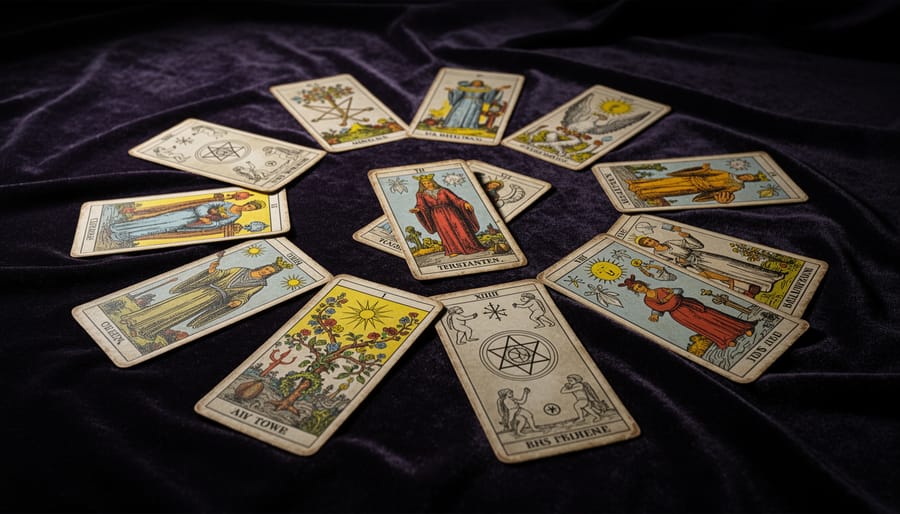
In Theosophical thought, Tarot symbols are understood as a visual language that encodes profound spiritual truths rather than tools primarily designed for divination. Each card functions as a carefully constructed repository of wisdom, containing layers of meaning that correspond to cosmic laws governing both the universe and individual consciousness. Theosophists view these symbols as universal, appearing across mystical traditions worldwide because they reflect fundamental patterns woven into the fabric of existence itself.
The cards represent more than pretty pictures or fortune-telling devices. They serve as maps charting the soul’s evolutionary journey from ignorance toward enlightenment, illustrating the stages of spiritual development every consciousness must traverse. When a Theosophist studies the Hanged Man or the Star, they’re not interpreting random imagery but engaging with archetypal forces that shape reality at every level, from the cosmic to the personal. These symbols connect directly to concepts like the true meaning of karma reincarnation, and the gradual refinement of the soul through countless incarnations.
Within this framework, Tarot becomes a teaching tool that reveals hidden knowledge to those who learn its symbolic vocabulary. The system operates on the principle that spiritual truths cannot be fully expressed in literal language but must be approached through symbols that speak to intuition and higher consciousness. Each image contains multiple dimensions of meaning that unfold progressively as the student’s understanding deepens.
- Archetypal Consciousness
- Universal patterns of energy and intelligence that underlie all manifestation, existing beyond individual minds yet expressing through them. These archetypes appear consistently across cultures because they represent fundamental cosmic forces.
- Correspondences
- The systematic relationships linking Tarot symbols to other esoteric systems like astrology, Kabbalah, elements, and chakras. These connections reveal how different symbolic languages describe the same underlying spiritual realities.
- The Path of Return
- The soul’s evolutionary journey from material existence back toward unity with the Divine Source. Tarot’s sequence mirrors this progressive spiritual ascent through stages of awakening and transformation.
- Planes of Existence
- The seven interpenetrating dimensions of reality in Theosophical cosmology, ranging from dense physical matter to pure spiritual consciousness. Different Tarot symbols correspond to different planes, mapping the full spectrum of existence.
- Macrocosm-Microcosm
- The principle that universal laws operating in the cosmos are reflected perfectly within the individual human being. Tarot symbols bridge both scales, showing how the same patterns govern galaxies and souls alike.
This perspective positions Tarot as part of the Ancient Wisdom tradition, a perennial philosophy expressed through different cultural forms but always pointing toward the same essential truths. The symbols become keys unlocking doors to knowledge that rational thought alone cannot access, inviting contemplation rather than mere intellectual analysis.
How Tarot Symbolism Works Within Theosophical Framework
Correspondences and the Web of Meaning
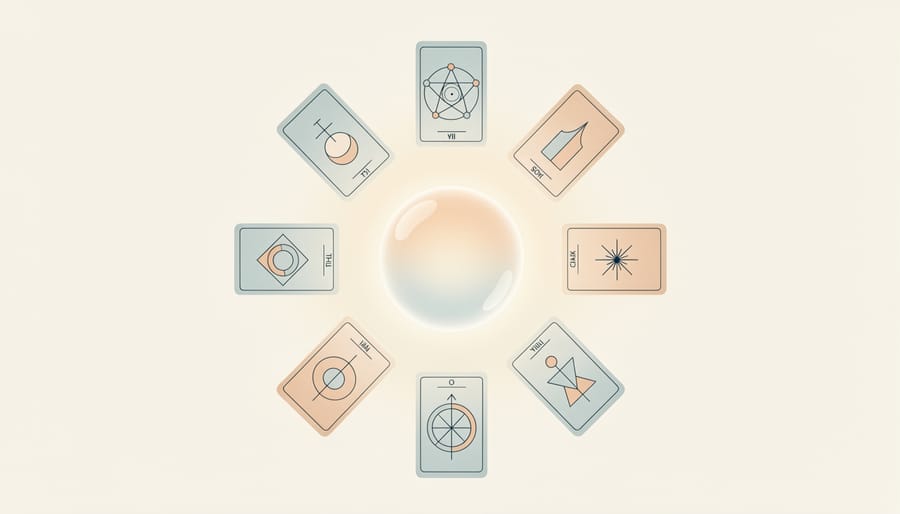
Theosophical philosophy treats Tarot not as an isolated system, but as a node in a vast network of symbolic languages. Each card becomes a meeting point where multiple esoteric traditions converge, reinforcing and illuminating one another.
Astrology provides one layer of this web: Major Arcana cards link to planetary forces and zodiacal energies. The Emperor, for instance, resonates with Aries and Mars, embodying assertive will and structural authority. These aren’t arbitrary assignments, Theosophists see them as recognition that the same archetypal forces manifest across different symbolic vocabularies.
The Kabbalistic Tree of Life offers another dimension. Cards map onto the ten Sephiroth (divine emanations) and the twenty-two paths connecting them, creating a diagram of consciousness descending from pure spirit into material form. The High Priestess, positioned on the path between Kether and Binah, represents the transmission of wisdom from the absolute source to structured understanding.
Eastern contributions deepen this tapestry. Chakras, energy centers along the spine, correspond to particular cards, with the seven-layered human system mirroring the cosmic seven planes. The four suits align with classical elements (fire, water, air, earth), which themselves relate to states of matter and consciousness.
This interwoven approach means studying one card becomes studying universal principles expressed through multiple lenses simultaneously. A single symbol opens dozens of doors, each revealing facets of the same underlying truth.
Tarot as a Mirror of Consciousness Evolution
In Theosophical thought, the Tarot deck unfolds as a visual narrative of consciousness awakening to its divine nature. The sequence isn’t arbitrary, it mirrors the soul’s descent into matter and its eventual return to spirit, a journey Theosophy describes as involution and evolution.
The Major Arcana traces this arc most clearly. Early cards like The Fool and The Magician represent the soul in its nascent state, stepping into manifestation with raw potential. As the sequence progresses through cards such as The Lovers and The Chariot, consciousness grapples with duality, desire, and willpower, the challenges of embodied existence. Mid-sequence cards like The Hermit and Death mark critical turning points where the soul begins withdrawing from material identification, undergoing necessary transformations.
Later cards, The Star, The Moon, The Sun, depict consciousness purifying itself, integrating lunar and solar principles, moving toward illumination. The final cards, The Judgement and The World, represent consciousness fully awakened, having completed a cycle of evolution and preparing for the next spiral of development.
This progression aligns with Theosophical teachings about root races and rounds, cycles of collective and individual spiritual maturation. Each card becomes a waypoint on the path, showing not just where consciousness currently stands but what lies ahead. The Minor Arcana echoes this journey in smaller cycles, showing how daily experiences contain seeds of the greater evolutionary process.
Components of the Tarot System in Theosophy
The Major Arcana: Keys to Universal Law
Within Theosophical thought, the 22 Major Arcana cards represent far more than simple pictorial symbols. They function as keys to universal law, each card embodying a cosmic principle that governs reality across all planes of existence. When viewed through a Theosophical lens these archetypal images map the soul’s evolutionary journey from spiritual ignorance to illuminated consciousness, mirroring the path every human traverses across multiple incarnations.
The sequence itself holds profound meaning. The Fool begins the journey as unmanifested potential, stepping into material experience without full awareness. As consciousness progresses through cards like the Magician (mastery of elemental forces), the High Priestess (intuitive wisdom), and the Hierophant (spiritual teaching), the soul encounters initiatory thresholds that test and refine its understanding. Mid-sequence cards such as the Wheel of Fortune reveal karmic cycles and the law of cause and effect, while the Hanged Man represents the necessary sacrifice of lower desires for higher vision.
Later cards, the Tower, the Star, the Moon, depict stages of spiritual crisis, hope, and illusion that precede final illumination. The World card completes the cycle, representing the perfected soul that has integrated all lessons and transcended the wheel of rebirth. Theosophists study these images not as predictive tools but as philosophical teachings, recognizing in each card a reflection of divine order and the structured unfoldment of consciousness itself.
The Minor Arcana: Everyday Spiritual Lessons
While the Major Arcana charts the grand cosmic blueprint, the Minor Arcana grounds these principles in the texture of everyday existence. Theosophists see the four suits, Wands, Cups, Swords, and Pentacles, as representing fundamental forces that permeate daily experience: creative will, emotional-intuitive development, mental clarity, and physical manifestation. Each isn’t merely a category but a field of consciousness through which spirit expresses itself in matter.
The numbered progression within each suit, from Ace to Ten, maps the descent of spiritual energy into increasingly concrete forms. An Ace represents the pure potential of its element entering manifestation, a divine spark. As the numbers advance, that energy encounters resistance, complexity, and refinement. The Five often signals crisis or imbalance, the turning point where consciousness must adapt. By the Ten, the principle reaches full expression in its element, ready to transform again.
This structure mirrors the Theosophical view of evolution as gradual unfoldment rather than random events. Daily challenges with relationships, work, thoughts, and resources become opportunities to embody spiritual laws. The Minor Arcana doesn’t predict fate, it reveals where consciousness currently engages matter and what lessons emerge from that encounter.
How Theosophists Use Tarot Symbolism in Practice
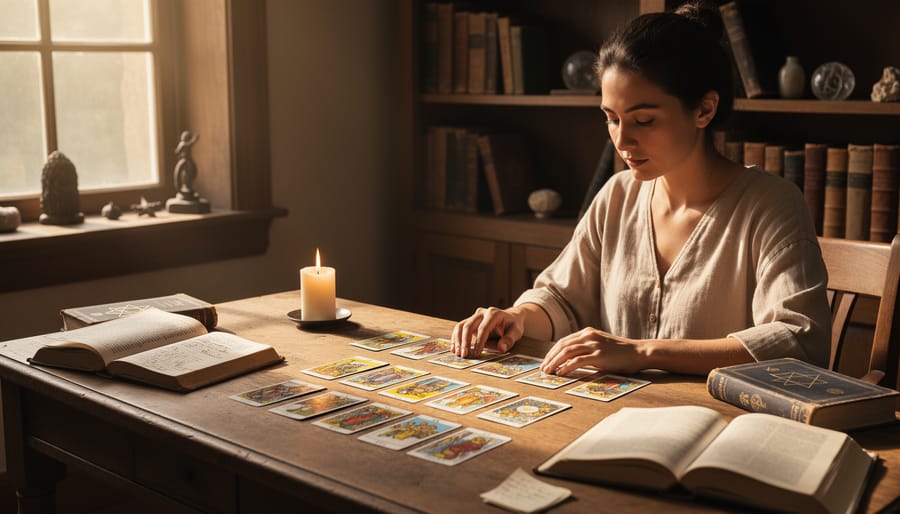
Theosophical practitioners engage with Tarot as a contemplative discipline rather than a predictive tool, treating each card as a doorway to deeper understanding. The most common practice involves daily card contemplation, where a student selects a single card and sits with it for fifteen to thirty minutes, noting the symbols, colors, relationships between figures, and emotional resonances that arise. This isn’t passive observation but active inquiry, asking questions like “What cosmic principle does this represent?” or “Where do I see this pattern in my own consciousness?”
Many Theosophists incorporate Tarot into structured meditation practices, using specific cards as focal points for concentration. A practitioner might meditate on The Hermit while reflecting on the search for inner wisdom, or use The Star during contemplation of spiritual aspiration. Some combine this approach with meditation with karma exploring how certain archetypal energies relate to cause-and-effect patterns in their lives. The card becomes a visual anchor that stabilizes the mind while opening pathways to intuitive insight.
Study groups frequently use Tarot as a teaching framework for explaining complex Theosophical concepts. An instructor might lay out the Major Arcana sequence to illustrate the soul’s evolutionary journey, or use the four suits to demonstrate how spiritual principles manifest across different planes of existence. This visual approach makes abstract ideas concrete, helping newcomers grasp relationships between concepts like involution and evolution, or the interplay between spirit and matter.
Personal development work represents another key application. Practitioners create symbolic spreads not to predict the future but to examine current psychological and spiritual patterns. A three-card layout might represent past conditioning, present consciousness, and potential growth, prompting self-reflection rather than fortune-telling. The cards serve as mirrors, revealing blind spots and highlighting areas requiring attention.
Some advanced students use Tarot for pathworking, a guided visualization technique where they imaginatively enter a card’s scene and interact with its symbols. Walking through The High Priestess’s temple or climbing The Fool’s mountain becomes an inner journey yielding personal revelations about universal truths. This practice treats the cards as living symbolic landscapes rather than static images, recognizing that each person’s encounter with an archetype will be unique while touching something universally human.
Historical Connections: Theosophy’s Influence on Tarot Interpretation
The relationship between Tarot and The Theosophical Movement emerged during the late 19th and early 20th centuries, when occultists began weaving together disparate esoteric traditions into coherent systems of spiritual knowledge. While Helena Blavatsky herself wrote little directly about Tarot, her synthetic approach to mysticism created fertile ground for others to explore the cards as philosophical tools.
The most profound influence flowed through secondary figures who absorbed Theosophical cosmology and applied it to Tarot interpretation. P.D. Ouspensky’s “The Symbolism of the Tarot” (1913) stands as a landmark text that explicitly connects Tarot imagery to Theosophical concepts of spiritual evolution and cosmic law. Ouspensky framed the Major Arcana as stages in the development of human consciousness, mirroring the Theosophical vision of souls ascending through planes of existence. His work transformed how esotericists approached the cards, shifting focus from fortune-telling to philosophical meditation.
Manly P. Hall, deeply influenced by Theosophical teachings, incorporated extensive Tarot analysis into “The Secret Teachings of All Ages” (1928). Hall positioned Tarot within a grand tapestry of universal wisdom, linking card symbols to Kabbalah, astrology, alchemy, and comparative religion, precisely the synthetic method Theosophy championed. His interpretations emphasized the cards as visual keys to hidden laws governing both cosmos and psyche.
The Hermetic Order of the Golden Dawn, though technically independent, operated in the same cultural ecosystem as Theosophy and absorbed many parallel ideas. Golden Dawn leaders like Arthur Edward Waite and Aleister Crowley created influential Tarot decks that encoded esoteric philosophy into visual form. Their systematic correspondences between cards, elements, planets, and Hebrew letters reflect the Theosophical impulse to demonstrate underlying unity across mystical traditions.
This cross-pollination fundamentally reshaped modern Tarot practice. What had been primarily a card game and folk divination method became a sophisticated symbolic language for exploring consciousness and universal principles. The Theosophical emphasis on spiritual evolution, hidden wisdom accessible through symbols, and the unity of all esoteric traditions became foundational assumptions in 20th-century Tarot interpretation, influencing countless decks, books, and teaching methods that followed.
Global Perspectives: Tarot and Theosophy Across Cultures
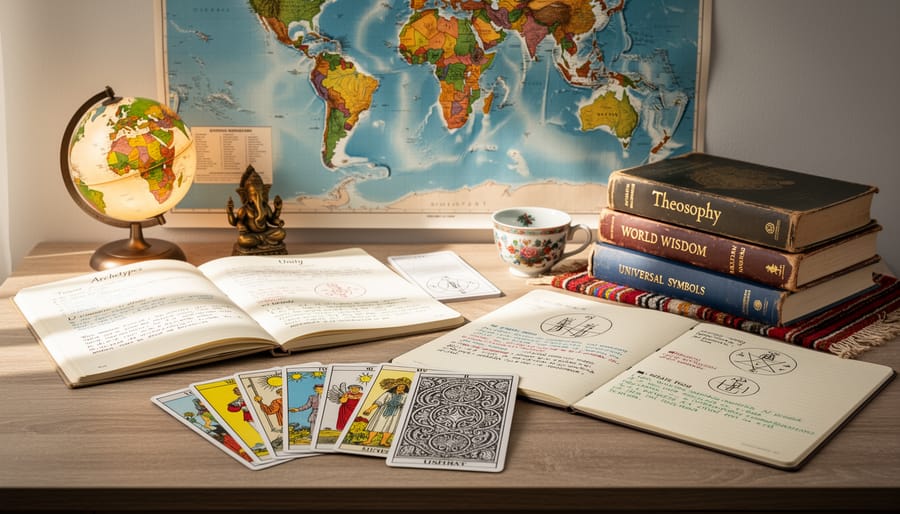
Theosophical societies from Jakarta to Buenos Aires have woven Tarot symbolism into their local spiritual vocabularies, creating interpretations that honor both universal principles and cultural specificity. This cross-pollination reveals how Tarot functions as a genuinely flexible symbolic language rather than a fixed Western construct.
In India and Southeast Asia, Theosophists frequently map Tarot archetypes onto indigenous concepts with striking coherence. The Hermit becomes a sannyasi in contemplative withdrawal. The Wheel of Fortune mirrors karma and samsara’s endless turning. Indian practitioners often reinterpret the court cards through the varna system or relate the four suits to the classical elements as understood in Ayurveda and Vedic cosmology. This isn’t forcing correspondence but recognizing parallel streams of symbolic thought that Theosophy’s founders explicitly acknowledged.
Latin American Theosophical groups have integrated syncretic spiritual traditions, blending Tarot with curanderismo and indigenous cosmologies. Mexican and Peruvian study circles sometimes read the Major Arcana through Mesoamerican sacred calendars or Andean concepts of reciprocity and balance. The Death card, for instance, might be explored through Día de los Muertos philosophy, where transformation and honoring ancestors intertwine.
African Theosophical communities, particularly in Kenya and South Africa, have drawn connections between Tarot’s archetypal journey and initiation systems within traditional wisdom schools. The symbolic language of masks, ancestors, and sacred roles finds resonance with court cards and Major Arcana figures.
What emerges across these cultural engagements isn’t dilution but enrichment. A Japanese practitioner might see the High Priestess through Shinto concepts of kami and sacred feminine energy. A Brazilian member might connect the Sun card to Umbanda’s solar deities. Each perspective reveals facets of the symbols that a purely European reading might miss, demonstrating Theosophy’s founding vision: that universal truths speak in many accents, and the symbolic language of Tarot adapts to the consciousness engaging with it.
Common Questions About Tarot in Theosophical Philosophy
Many newcomers to Theosophical study encounter Tarot references in classic texts and wonder how the cards fit into the broader philosophy. Questions naturally arise about the relationship between these colorful symbolic images and the systematic worldview Theosophy presents. Understanding a few key distinctions helps clarify the role Tarot plays, and doesn’t play, in Theosophical practice.
Is studying Tarot required to practice Theosophy?
No, Tarot is one symbolic system among many that some Theosophists find useful, but it’s not a prerequisite for studying Theosophical philosophy. Core Theosophical teachings stand independently of any particular symbolic framework.
How does the Theosophical approach differ from popular Tarot reading?
Theosophists primarily use Tarot for philosophical contemplation and studying universal principles rather than predictive fortune-telling. The cards serve as meditation aids and teaching tools for understanding cosmic laws and consciousness evolution.
Can someone new to both Theosophy and Tarot work with the symbols?
Absolutely. Many find the visual nature of Tarot symbols makes abstract Theosophical concepts more accessible. Start with one card at a time, contemplating its imagery and relating it to Theosophical principles you’re learning through reading and study groups.
What resources exist for deeper study of this connection?
Classic texts like P.D. Ouspensky’s “The Symbolism of the Tarot” and Manly P. Hall’s writings provide philosophical frameworks, while local Theosophical Society lodges often host study groups exploring symbolic systems including Tarot.
The most persistent misconception is that Theosophical engagement with Tarot centers on divination or predicting personal futures. In reality, Theosophists treat the deck as a teaching tool, a way to visualize and internalize abstract spiritual principles. When someone sits with the Hermit card, they’re not asking “Will I be alone?” but rather contemplating the necessary solitude that accompanies inner illumination, the withdrawal from worldly distractions that precedes deeper understanding.
Another common question concerns whether there’s a “correct” Theosophical deck. Since Theosophy emphasizes principles over rigid forms, practitioners work with various decks, some prefer traditional Marseille imagery for its archetypal simplicity, others use Rider-Waite-Smith for its rich symbolic detail, and still others design their own systems reflecting specific Theosophical concepts. The deck itself matters less than the depth of contemplation you bring to the symbols.
Tarot symbolism in Theosophical philosophy ultimately functions as a meeting point where analytical thought and intuitive knowing converge. The cards don’t demand you choose between rigorous study and contemplative insight, they ask for both. When you approach Tarot as Theosophists do, you’re not memorizing fixed meanings but developing a flexible symbolic literacy that deepens with practice and reflection.
This approach transforms Tarot from a static system into a living conversation between ancient wisdom and your personal spiritual journey. Each time you sit with a card’s imagery, you bring your unique cultural background, life experiences, and questions to the encounter. That’s not a limitation, it’s what keeps the tradition vital and responsive.
The beauty of Theosophical Tarot interpretation lies in its openness. There’s no single authoritative reading, no closed canon of correct meanings. Different practitioners see different layers depending on their spiritual development, cultural lens, and the particular wisdom traditions they draw from. An interpretation rooted in Buddhist philosophy might illuminate aspects someone approaching from Hermetic Kabbalah wouldn’t notice, and vice versa.
If you’re drawn to explore Tarot as a contemplative tool rather than a fortune-telling device, start simply. Choose one card and sit with it regularly. Notice what surfaces. Share your insights with others walking similar paths. The community’s collective wisdom often reveals dimensions no individual could access alone, and your perspective adds to that expanding tapestry of understanding.