melissa
 In the landscape of spiritual seeking, few organizations have shaped Western esoteric thought as profoundly as the Theosophical Society in America. Founded in 1875 in New York City by Helena Petrovna Blavatsky, Henry Steel Olcott, and William Quan Judge, this pioneering movement emerged at a remarkable crossroads of science, religion, and philosophy, offering seekers an alternative to both rigid materialism and dogmatic faith.
The Theosophical Society in America stands as the primary American branch of a global network dedicated to exploring the hidden dimensions of existence. While theosophical organizations exist worldwide, TSA distinguishes itself through its uniquely American character: an emphasis on democratic spirituality, practical mysticism, and the integration of Eastern and Western wisdom traditions within a pluralistic framework. Unlike hierarchical religious institutions, it operates as a voluntary association where members pursue their own spiritual investigations while contributing to collective understanding.
What makes TSA significant today is its enduring commitment to three foundational objectives: forming a nucleus of universal brotherhood without distinction of race, creed, sex, caste, or color; encouraging comparative study of religion, philosophy, and science; and investigating unexplained laws of nature and human potential. These principles, radical in 1875, remain urgently relevant as humanity grapples with division, materialism, and existential questions about consciousness and purpose.
For those new to theosophy, think of TSA as both a library and a laboratory: a place where ancient wisdom meets contemporary inquiry, where diverse perspectives converge in respectful dialogue, and where individual seekers find community without surrendering intellectual freedom. Whether you approach from Buddhism, Christianity, secularism, or simply curiosity, TSA offers pathways into perennial questions that transcend cultural boundaries while honoring the wisdom each tradition brings.
The Birth and Early Evolution of the Theosophical Society in America
From New York to Wheaton: The Journey to Establishing Roots
The Theosophical Society’s American story began in New York City in 1875, where founders Helena Blavatsky, Henry Steel Olcott, and William Quan Judge first gathered to explore universal brotherhood and spiritual wisdom. But like many spiritual movements, the organization’s physical home would shift as it evolved and grew.
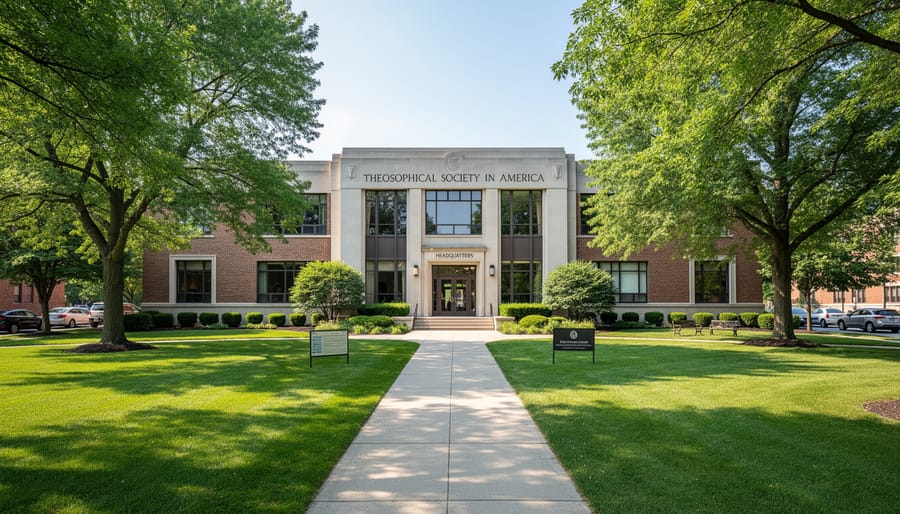
For decades, the American headquarters moved between locations, reflecting the society’s growing pains and changing needs. This nomadic period ended in 1926 when the Theosophical Society in America found its permanent home in Wheaton, Illinois, a quiet suburb west of Chicago. The move wasn’t just about finding office space. It represented a conscious decision to create a sanctuary for contemplation, learning, and community gathering away from the hustle of major metropolitan centers.
The Wheaton campus transformed American theosophy in meaningful ways. It became more than administrative offices. The grounds featured libraries housing rare manuscripts and texts from spiritual traditions worldwide, meeting spaces for study groups and lectures, and peaceful gardens inviting reflection. This physical rootedness allowed TSA to shift from a primarily intellectual movement to one emphasizing lived community experience.
Having a stable headquarters meant American theosophists could build lasting programs, host international visitors, and preserve important documents that might otherwise have been lost. The Wheaton location symbolized something deeper: a commitment to making theosophical wisdom accessible to everyday seekers, not just urban intellectuals. It democratized access to these teachings and created a welcoming space where curiosity could flourish across backgrounds and beliefs.
Key Figures Who Shaped the American Branch
The American branch of the Theosophical Society has been shaped by remarkable individuals who brought the vision of H.P. Blavatsky and her co-founders into resonance with American spiritual seekers. While Blavatsky herself spent time in America, establishing the society’s first headquarters in New York, it was subsequent leaders who helped root theosophy in American soil.
William Quan Judge, one of the original co-founders, became instrumental in developing the American section’s distinct identity. His accessible writings and dedication to building local lodges across the country made theosophical ideas available beyond elite circles. Judge emphasized practical spirituality and democratic access to wisdom, values that aligned well with American ideals.
Katherine Tingley brought social activism to the forefront, founding the Point Loma community in California as a living experiment in theosophical principles. Her work demonstrated how ancient wisdom could address modern social challenges, from education reform to humanitarian service.
Later, figures like Grace Knoche and Joy Mills continued this tradition of making theosophy relevant to contemporary audiences. They bridged Eastern and Western philosophical traditions while encouraging critical thinking and personal exploration rather than dogmatic acceptance.
These leaders shared a commitment to inclusivity and dialogue across cultural boundaries. They understood that theosophy’s universal principles could speak to diverse communities when presented with respect and clarity, creating a distinctly American expression of this global spiritual movement.
TSA’s Place Within the Global Theosophical Network
Understanding the Different Theosophical Branches Worldwide
For newcomers exploring theosophy, the organizational landscape can initially seem puzzling. Multiple societies use similar names, yet operate independently—each with its own history and approach. Understanding these connections helps clarify where the Theosophical Society in America fits within the broader movement.
The theosophical movement essentially split into several branches following organizational disputes in the early 20th century. Today, three main groups exist globally. The largest is the Theosophical Society with its international Adyar headquarters in Chennai, India, which maintains a presence in about sixty countries. The Theosophical Society in America is the official American section of this Adyar-based organization, maintaining close ties while serving North American members specifically.
A second branch, the United Lodge of Theosophists, emerged in 1909 emphasizing a return to original teachings without formal leadership hierarchies. Meanwhile, the Theosophical Society Pasadena represents another distinct lineage, tracing its authority through different succession lines from the founders.
Think of these organizations as branches of a family tree—sharing common roots in the original society founded by Helena Blavatsky and Henry Steel Olcott in 1875, yet having developed their own characteristics over time. They’re not competing religions but rather different organizational approaches to preserving and sharing theosophical wisdom.
What matters most for spiritual seekers is that despite administrative separations, all branches generally respect the core principles: investigating life’s mysteries, promoting universal brotherhood, and encouraging comparative study of philosophy and religion. Each organization offers legitimate pathways into theosophical study, with variations in emphasis and presentation rather than fundamental contradictions in teachings.
How TSA Collaborates and Differs from Sister Organizations
The Theosophical Society in America maintains a collaborative relationship with sister organizations worldwide while honoring the unique expressions that emerge from different cultural contexts. Think of it as a family where siblings share core values but develop their own personalities and approaches.
TSA actively participates in global theosophical gatherings, sharing resources, speakers, and educational materials with organizations like the Theosophical Society Adyar in India, the Theosophical Society in England, and branches across Europe, Asia, and Latin America. These exchanges enrich everyone involved, bringing fresh perspectives on ancient wisdom teachings and contemporary spiritual questions.
Where TSA particularly shines is in its emphasis on American diversity and democratic engagement. While maintaining the foundational principles of universal brotherhood, investigation of nature’s laws, and comparative study of religions, TSA has developed programs that speak to contemporary American spiritual seekers. Its approach tends to be more conversational and accessible, reflecting cultural values of openness and individual exploration.
Sometimes differences arise, typically around organizational structure or interpretations of theosophical teachings. These aren’t conflicts but healthy expressions of diversity. One society might emphasize traditional study methods, while another experiments with modern digital formats. Some focus heavily on Eastern philosophies, while others integrate Western esoteric traditions more prominently.
This diversity strengthens the global movement. When each organization learns from its unique community while staying connected to the worldwide network, theosophy remains both rooted in timeless wisdom and responsive to evolving human needs. Unity doesn’t require uniformity.

What Makes the Theosophical Society in America Unique
The Quest Bookshop and Publishing Legacy
One of the Theosophical Society in America’s most enduring contributions to spiritual seekers worldwide has been its commitment to publishing and sharing transformative literature. At the heart of this mission stands Quest Books, the publishing arm that has made profound philosophical ideas accessible to curious minds for decades.
Established to bridge ancient wisdom and contemporary understanding, Quest Books has released hundreds of titles exploring meditation, comparative religion, mysticism, yoga, and Eastern philosophy. What makes this publishing legacy special isn’t just the breadth of topics covered, but the intentional effort to present complex spiritual concepts in language that welcomes both newcomers and experienced practitioners. This approach reflects the Society’s broader vision of fostering genuine dialogue across different traditions and perspectives.
The Quest Bookshop, originally located at the Wheaton headquarters, served as more than a retail space. It became a gathering point where people from diverse backgrounds could discover books that might answer their deepest questions about existence, consciousness, and human potential. From translations of classical theosophical texts to works by contemporary spiritual teachers, the selection honored various wisdom traditions.
Through this publishing work, TSA has helped democratize access to spiritual philosophy, ensuring these teachings aren’t confined to academic circles or exclusive groups. Instead, they’ve created pathways for anyone genuinely interested in exploring life’s profound questions to find guidance, inspiration, and community through the written word.

Programs, Education, and Community Building
The Theosophical Society in America offers a rich tapestry of programs designed to make spiritual exploration accessible and engaging for everyone, regardless of where they are on their journey. At the heart of these offerings is the Olcott campus in Wheaton, Illinois, which hosts retreats, workshops, and summer camps that bring people together for immersive learning experiences. These gatherings create spaces where participants can explore meditation practices, dive into philosophical discussions, and connect with like-minded seekers in a supportive environment.
For those who can’t travel to Wheaton, TSA has embraced digital platforms to reach a global audience. Their online courses cover everything from fundamental theosophical concepts to comparative religion and esoteric philosophy. These virtual offerings ensure that geographical boundaries don’t limit anyone’s access to wisdom traditions and transformative teachings.
The organization’s lending library and bookstore provide extensive resources for independent study, while their Quest Books imprint publishes works that bridge ancient wisdom and contemporary spiritual inquiry. Regular webinars and virtual discussion groups foster ongoing dialogue, allowing participants from diverse cultural backgrounds to share perspectives and learn from one another.
Local study centers and lodges across the United States serve as community hubs where people gather for study groups, meditation sessions, and cultural events. These grassroots initiatives embody theosophy’s emphasis on universal brotherhood by creating welcoming spaces where questions are encouraged, diverse viewpoints are honored, and spiritual exploration becomes a shared adventure rather than a solitary pursuit.

TSA’s Influence on American Spirituality and Culture
The Theosophical Society in America has quietly shaped American spiritual culture in ways that extend far beyond its membership rolls. Since its earliest days, TSA has served as a catalyst for conversations that challenge conventional religious boundaries and invite people to explore spirituality on their own terms.
Perhaps most significantly, TSA helped normalize the idea that wisdom traditions from different cultures could coexist and complement one another. At a time when American religious discourse was predominantly Christian and often exclusionary, theosophists were introducing concepts from Hinduism, Buddhism, and other Eastern philosophies to mainstream audiences. This cross-pollination didn’t just inform academic study; it filtered into popular culture, influencing everything from literature and art to practices like yoga and meditation that millions of Americans now embrace daily.
The Society’s emphasis on comparative religion laid groundwork for what we now call interfaith dialogue. By insisting that all religions contain kernels of universal truth, TSA encouraged people to look for common ground rather than differences. This perspective resonated particularly during times of social upheaval, offering an alternative to religious dogmatism and sectarianism. Today’s vibrant interfaith movement owes a debt to these early bridge-builders who dared to suggest that spiritual seekers could learn from multiple traditions without betraying their own paths.
TSA’s impact on American spirituality also manifests in subtler ways. The notion that individuals can forge their own spiritual journeys, that ancient wisdom remains relevant to modern problems, that mystical experience deserves serious consideration alongside rational thought—these ideas, once considered radical, now feel almost commonplace. The Society helped create space for what scholar Catherine Albanese called “metaphysical religion” in America, a spiritual orientation that values personal experience, universal laws, and esoteric knowledge.
The organization’s community-driven approach has fostered countless local study groups, lectures, and gatherings where people from diverse backgrounds explore profound questions together. These spaces model a different kind of spiritual community—one built not on shared dogma but on mutual respect, intellectual curiosity, and the recognition that we’re all fellow seekers. This collaborative spirit continues to influence how Americans think about spiritual community, moving beyond hierarchical structures toward more egalitarian, discussion-based formats that honor multiple perspectives and invite everyone to contribute their unique insights to the collective search for truth.
Challenges and Evolution in the Modern Era
Like many spiritual and philosophical organizations founded in the 19th century, the Theosophical Society in America faces distinct challenges in navigating the 21st century landscape. Membership numbers have declined from their mid-20th century peak, reflecting broader trends affecting traditional spiritual organizations. The average age of members has gradually increased, raising important questions about how to connect theosophical wisdom with younger seekers who often approach spirituality through different channels.
The digital transformation has become both a challenge and an opportunity. While TSA has embraced online platforms, offering virtual study groups, webinars, and streaming content from Olcott, the heart of theosophy has always been face-to-face dialogue and community building. How do you create that sense of genuine spiritual fellowship through a screen? TSA is experimenting with hybrid models that blend in-person gatherings with digital accessibility, recognizing that geographical barriers shouldn’t prevent anyone from exploring these teachings.
Relevance is another pressing concern. In an era of quick fixes and instant gratification, theosophical study requires patience, contemplation, and sustained engagement with complex ideas. Yet this very depth might be precisely what many are seeking amid our fragmented digital age. TSA is working to reframe its ancient wisdom for contemporary issues like environmental crisis, social justice, and mental health, demonstrating that core principles of universal brotherhood, interconnectedness, and spiritual evolution remain profoundly relevant.
The organization is also examining its own history with fresh eyes, acknowledging past exclusions while working toward genuine inclusivity. This means welcoming diverse voices, honoring multiple wisdom traditions equally, and ensuring that theosophical spaces feel accessible to people of all backgrounds.
Through these adaptations, TSA strives to preserve what makes theosophy valuable, its invitation to think deeply, question freely, and recognize our fundamental unity, while making these timeless principles speak to the urgent needs of our contemporary world. The evolution continues, guided by the understanding that living traditions must grow while honoring their roots.
How to Connect with TSA and the Global Theosophical Community
Connecting with the Theosophical Society in America offers a meaningful gateway into a vibrant global community dedicated to exploring life’s deepest questions. Whether you’re just beginning your journey into theosophical ideas or have been engaging with these teachings for years, TSA provides multiple avenues for participation and growth.
The most direct way to engage is through becoming a member, which grants you access to a wealth of resources including the society’s extensive library collections, exclusive publications like Quest Magazine, and invitations to members-only study groups and lectures. Membership connects you not only with fellow seekers across America but also links you to the international theosophical network, opening doors to gatherings and resources worldwide.
TSA hosts numerous events throughout the year, from weekend workshops and speaker series at the Wheaton headquarters to regional gatherings and virtual presentations that bring together diverse voices exploring theosophical themes. These events create spaces for dialogue where newcomers and experienced practitioners can share insights and questions together.
For those who prefer digital engagement, TSA maintains active online forums, social media communities, and a comprehensive website featuring articles, lectures, and educational materials. These platforms make theosophical wisdom accessible regardless of your location and allow for ongoing conversations with a global community.
The beauty of connecting through TSA is that it naturally extends outward. Through its relationships with sister organizations worldwide, TSA can help you discover theosophical groups in other countries, attend international conventions, and participate in cross-cultural exchanges that enrich your understanding of universal brotherhood in action. Your local connection becomes a doorway to a worldwide movement dedicated to truth-seeking and spiritual exploration.
The Theosophical Society in America stands as a vibrant thread in the rich tapestry of global theosophy, demonstrating how universal spiritual principles can take root and flourish within diverse cultural contexts. Throughout its history, TSA has maintained a delicate balance between honoring the foundational teachings that connect all theosophical organizations while embracing distinctly American expressions of inquiry, innovation, and inclusivity.
What makes TSA particularly valuable today is its commitment to creating spaces where different perspectives can meet, dialogue, and enrich one another. In an era when spiritual seekers often feel caught between rigid orthodoxy and directionless eclecticism, TSA offers a middle path grounded in study, fellowship, and personal experience. Its ongoing contributions to interfaith dialogue, its support for comparative religion and philosophy, and its emphasis on personal transformation through understanding demonstrate that theosophy remains deeply relevant to contemporary spiritual questions.
Whether you’re encountering these ideas for the first time or have walked this path for years, the theosophical community welcomes your voice and your questions. TSA’s network of lodges, study centers, and online resources provides numerous entry points for engagement, from casual exploration to deep immersion. The beauty of theosophy lies not in passive acceptance but in active investigation, and every genuine seeker contributes something valuable to the collective wisdom.
We invite you to explore further, attend a local gathering, join online discussions, or simply begin your own contemplative journey with theosophical texts. The path of wisdom thrives on diversity, curiosity, and open hearts.