melissa
In Theosophy, karma is the impersonal law of cause and effect that links every thought, word, and action to its consequences, across this life and the lives that follow. It isn’t a cosmic scorekeeper handing out rewards and punishments. Think of it as a principle of harmony: when we disturb the balance of things, the universe moves, without malice, to restore it, and we’re the ones who learn from the adjustment.
That distinction matters. Many people meet the word through a pop-culture shorthand of “what goes around comes around,” and miss the deeper idea: that we shape our own character and circumstances through the choices we make, and that reincarnation gives those choices time to bear fruit. The same insight echoes in traditions worldwide, from Hindu and Buddhist teachings to ideas of moral reciprocity in many other cultures, each with its own emphasis.
In this article, we’ll define karma in plain language, explain how the law operates and how it relates to reincarnation, look at the types of karma described in Theosophical literature, and consider what it all means for daily life and ethics. Whether you’re new to these ideas or have studied them for years, we invite you to bring your own perspective and questions along.
What Karma Means in Theosophy: A Plain-Language Definition

Karma Is Not Punishment or Fate
Many people first meet karma as a kind of cosmic scorekeeping: do good and get a reward, do wrong and get punished. Others hear it as fatalism, as if everything that happens was fixed long ago. Theosophy sees it differently. Karma is an impersonal law, closer to gravity than to a judge. No one sits in judgment, and nothing is handed out as a prize or a penalty. Actions simply set up effects that ripple back toward restoring harmony. This echoes older threads of thought, and readers who enjoy tracing them may find Plato’s philosophy a useful companion for the ideas of cosmic order and the soul’s journey.
Because the law is impersonal, human choice stays central. We aren’t puppets of past deeds; each moment offers a fresh decision that shapes what comes next. It also means karma should never become a reason to blame those who suffer, since we rarely see the full picture of anyone’s life. Many cultures hold their own rich, varied understandings of karma, and these deserve respect rather than correction.
A few terms help here:
- Karma
- Action and its consequences, the principle that every cause produces a corresponding effect.
- Karmic law
- The impersonal, universal tendency of the cosmos to restore balance and harmony.
- Nemesis
- A term used in some Theosophical writings for karma’s corrective, balancing aspect, not for vengeance.
- Reincarnation
- The soul’s repeated return to earthly life, providing the stage on which karmic effects unfold.
- Dharma
- Right duty or the path of right living, often seen as working with karma rather than against it.
Seen this way, karma invites responsibility rather than fear.
How Karma Works: Cause, Effect, and the Wheel of Rebirth
Thought, Word, and Deed: Where Karma Begins
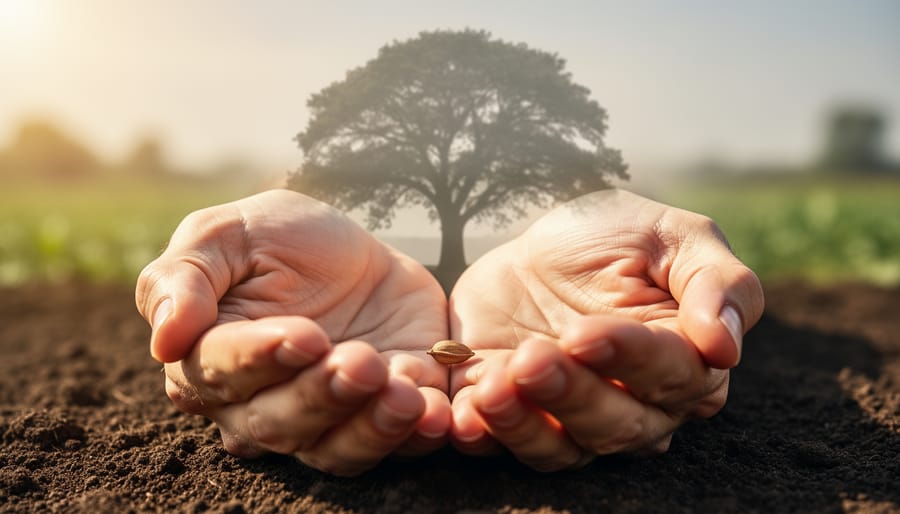
In Theosophical teaching, karma doesn’t begin with the visible deed alone. It begins earlier, in the motive behind it. A thought is already a kind of action, because it shapes our inner state, colors how we see others, and quietly prepares the words and deeds that follow. Students often describe it as a chain: intention gives rise to speech, and speech gives rise to action, with each link carrying the quality of the one before.
Consider a simple example. Two people each give a friend a thoughtful gift. One does it out of real care. The other does it hoping to be admired or to gain a favor later. From the outside, the act looks identical. In Theosophical thinking, though, the intention marks the difference, because it sets up a different cause and, in time, a different kind of effect.
This is why the tradition stresses inner honesty. Watching our motives, noticing the small resentments or generous impulses behind what we say and do, becomes a form of ethical practice in itself. It isn’t about guilt or perfection. It’s about recognizing that the seeds of karma are sown quietly, long before anything happens in the outer world.
What do you notice about your own motives in everyday moments?
Karma and Reincarnation: Two Ideas Working Together

A single lifetime is rarely long enough for every cause to meet its effect. A kindness offered at twenty might not bear fruit until much later, and some choices seem to leave no visible trace at all. Theosophy answers this puzzle by pairing karma with reincarnation. Rebirth supplies the continuity: the same evolving soul carries the results of its past thoughts and deeds forward into new lives, so nothing is lost and nothing is left unbalanced.
In this view, karma and reincarnation are not two separate doctrines but two sides of one process. Karma explains why our circumstances, tendencies, and opportunities take the shape they do. Reincarnation explains how there is time enough for those causes to ripen. Each life offers fresh conditions in which the soul can meet old consequences, learn from them, and make different choices.
Theosophical writers describe this as long-term evolution. The soul gradually deepens its understanding, compassion, and capacity for wise action across many lives, with karma acting as the teacher and rebirth as the classroom. It is worth remembering that not everyone finds this picture convincing, and Theosophical students hold a range of views on its details. If you come from a tradition that sees continuity differently, your perspective is a welcome part of the conversation.
The Different Kinds of Karma in Theosophical Teaching
Theosophical writers rarely hand us a single, tidy chart of karma. Different authors, drawing on Hindu and Buddhist sources, stress different divisions, and the vocabulary shifts from book to book. It helps to treat the categories below as lenses for looking at the same law, not as separate boxes.
- Individual karma: the consequences that return to a person from their own thoughts, words, and actions.
- Collective karma: the shared results of what families, nations, and humanity as a whole set in motion together.
- Karma already unfolding: causes from the past that are ripening now and shaping present circumstances.
- Karma yet to ripen: causes stored up that have not yet come to fruition, along with the new causes we are creating today.
The last pair echoes older Indian classifications. Hindu teaching, for instance, speaks of karma that has begun to bear fruit (often called prarabdha), karma accumulated but not yet ripened (sanchita), and karma being made in the present (kriyamana or agami). Buddhist thought has its own ways of sorting karma, often focused on intention and its results. Theosophical writers borrow from these streams without always using the same terms, which is why two teachers may describe “the same” idea quite differently.
Collective karma deserves a note of its own, since it reflects the Theosophical stress on human interdependence. If we are bound together as one family, then the effects of our choices naturally reach beyond ourselves. That does not erase personal responsibility. It widens it.
Which of these lenses feels most familiar from your own tradition? Many of our readers find that comparing notes reveals how much these ideas overlap.
How Karma Is Used: From Personal Ethics to Universal Brotherhood
Karma as a Guide for Everyday Choices
Many students find karma most useful as a lens for reflection rather than a rulebook. In relationships, it might mean pausing before a sharp reply and asking what kind of seed you are planting. At work, it can shift attention from outcomes alone to the care and honesty behind your effort. In quiet moments of self-reflection, it invites you to notice recurring patterns without judging yourself harshly.
None of this requires a fixed formula. Some students keep an evening habit of reviewing the day’s choices, while others simply try to act with a little more awareness. Ethical teachings from other traditions can enrich this practice too. For example, you might read Paul’s letter and consider how its themes of conduct and community echo ideas of cause and effect. The aim is steady, gentle attentiveness rather than perfection.
Karma and Compassion: Avoiding the Blame Trap
A common trap is to look at someone’s hardship and conclude, “they must have earned it.” Theosophical teachers have long pushed back on this. Karma explains the pattern of cause and effect across a life, but it never gives us permission to stand back from another person’s pain. If anything, it asks the opposite of us. Since we can’t see the full web of causes behind anyone’s circumstances, judging them is both presumptuous and unhelpful.
In practice, Theosophists tend to see another person’s suffering as an invitation to act, whether through practical help, patient listening, or simply showing up. A genuine philosophy of inclusion reminds us that no one stands outside the circle of our concern.
It also helps to stay sensitive to culture. In many communities, karma is a deeply personal, sacred idea, and casually using it to explain someone’s loss can wound rather than comfort. When in doubt, offer compassion first and theory later.
Common Questions About Karma in Theosophy
Karma raises a lot of questions, and thoughtful students answer them in different ways. Here are a few of the most common, with the Theosophical perspective in plain terms.
Is karma the same in Theosophy as in Hinduism or Buddhism?
Theosophy draws heavily on both traditions, so the core idea of action and consequence is shared. Emphasis and terminology differ, though, and Theosophical writers often frame karma as a universal law of harmony working across lifetimes.
Can karma be changed or lessened?
Many Theosophical students understand karma as responsive to our present choices. New thoughts, motives, and actions set fresh causes in motion, so the future is shaped by what we do now, not only by what came before.
Does karma mean everything is predetermined?
Not in the usual Theosophical reading. Karma is treated as impersonal law, not fate, and human responsibility and free will remain central to how we meet whatever circumstances arise.
How does karma relate to free will?
Past causes shape the conditions we find ourselves in, but we choose how to respond. That response, driven by intention, is where new karma begins.
Of course, these short answers only scratch the surface. Different Theosophical traditions, and readers from different cultural backgrounds, often see these questions in their own light. If you’d like to compare views, ask your own question, or share how your tradition understands karma, we’d love to hear from you in the community forums.
Looking back, the Theosophical view of karma is less a ledger of rewards and punishments than a quiet law of harmony. Every thought, word, and deed sets something in motion, and what returns to us is meant to teach rather than to condemn. Paired with reincarnation, this gives the soul room to learn across many lives, and it asks something of us now: to act with care, to meet others’ hardships with compassion instead of blame, and to remember that our choices ripple outward into the shared life of humanity.
Of course, this is one way of looking at an idea that many traditions have shaped over thousands of years. Your own understanding may come from Hindu or Buddhist teaching, from another faith, or simply from what life has shown you. None of that is out of place here. We’d love to hear how your background colors the way you think about cause and effect. Bring your questions, your doubts, and your stories to our forums, or contribute something to the community. The conversation is richer for every voice in it.