melissa
Endotoxin testing and sterility testing answer two different questions about a research-grade peptide. Sterility testing asks whether living microorganisms are present. Endotoxin testing asks whether fragments of bacterial cell walls remain, even after the bacteria themselves are gone. A vial can pass one and fail the other, which is why a single “tested” label tells you very little. If you plan to buy peptides Canada suppliers offer, learning to read what each test actually covers is the most useful skill you can bring to the table.
Endotoxins are lipopolysaccharides from Gram-negative bacteria. They survive heat, filtration, and many cleaning steps that kill the organism itself. Labs typically detect them with the Limulus amebocyte lysate (LAL) assay, a reaction first developed from horseshoe crab blood, and report results in endotoxin units per milliliter. Sterility testing works differently: a sample is incubated in growth media for days to see whether anything grows. Same vial, two very different windows into its quality.
Why does this matter beyond the lab bench? Because claims are easy to make and certificates are easy to misread. A line on a product page saying “sterile” or “endotoxin tested” may mean a rigorous batch-specific report, or it may mean very little at all.
This kind of careful questioning has a long pedigree. The same habit of mind behind theosophy discernment, weighing a claim before accepting it, applies just as well to a certificate of analysis. Researchers worldwide hold these standards to different regulatory expectations, so we’ll keep the conversation open to your experience too. Everything here concerns research use only, not medical advice.
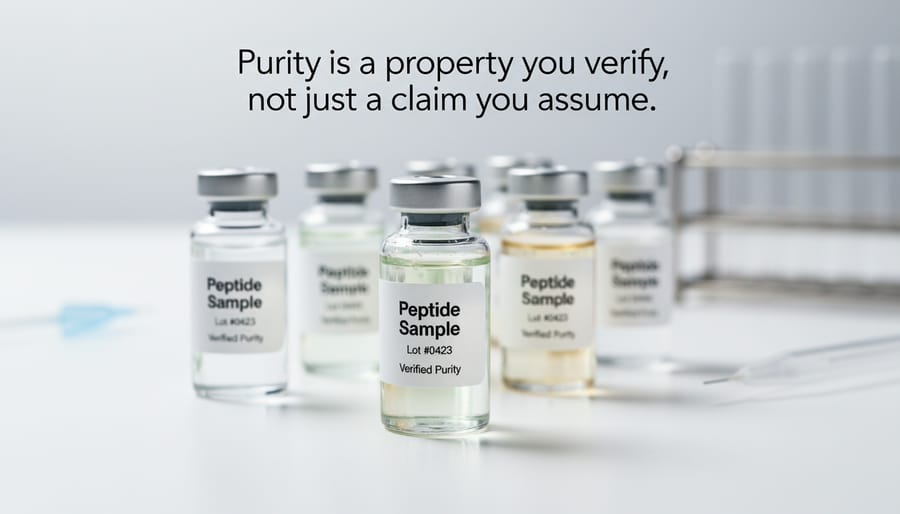
Why Purity Is More Than a Number on a Label
Research-Grade Versus Pharmaceutical-Grade Peptides
When people see the phrase “research-grade,” it can sound like a seal of quality, but it really describes intended use. These peptides are made for laboratory experiments, not for people or animals. That distinction shapes everything around them.
Pharmaceutical-grade material is produced under strict, legally enforced manufacturing rules. Regulators inspect facilities, batches are documented in detail, and sterility and endotoxin limits are set and verified before anything reaches a patient. Research-grade production usually has lighter oversight. Standards vary widely between suppliers, and many follow their own internal quality systems rather than a single binding framework.
That doesn’t make research-grade material poor, but it does mean the burden of discernment shifts to the reader. It echoes an old question in Plato’s philosophy: how do we tell the appearance of a thing from its underlying reality? A label alone can’t answer that. Testing data and transparent documentation can, which is why the next sections matter.
How Hidden Contamination Skews Results
Imagine a researcher treating cells with a peptide and seeing a strong inflammatory response. It looks like a discovery. But the peptide itself may not have caused it. Endotoxins can switch on immune signaling in cells at remarkably small amounts, so a contaminated vial can produce a dramatic effect that has nothing to do with the molecule under study.
That is the quiet danger. The signal is real, yet its source is mistaken. One lab sees the response, another lab with a cleaner batch does not, and the results refuse to reproduce. Weeks can go into chasing an explanation that was never about the peptide at all.
Living microbes cause a different kind of trouble. They consume nutrients, shift the pH, and release their own compounds, which can cloud cell cultures and distort readings. In both cases, the experiment appears to speak, but what we hear is the contaminant. Careful testing is how we learn to tell the two voices apart.
Endotoxins and Sterility: Two Different Questions

What Endotoxins Are and Why They Persist
Endotoxins are pieces of the outer membrane that wrap certain bacteria, and they are easy to misunderstand because they are not alive. A bacterium can be killed, filtered out, or burst open, yet its structural remnants stay behind in the solution. That is the heart of the problem.
A few terms help here:
- Gram-negative bacteria
- A broad group of bacteria with a thin cell wall wrapped in an extra outer membrane, which is where endotoxin sits.
- Endotoxin
- A fragment of that outer membrane that remains after the bacterium dies or breaks apart.
- Lipopolysaccharide (LPS)
- The specific molecule in the outer membrane that gives endotoxin its biological activity; the two terms are often used interchangeably.
- Pyrogen
- Any substance that can provoke a fever response, with endotoxin being the best-known example.
- Endotoxin unit (EU)
- The standard measure used to report how much endotoxin activity a sample contains.
Endotoxins persist because they are remarkably sturdy. Many routine sterilization steps are designed to kill living organisms, not to dismantle stable molecules like LPS, which can tolerate heat and chemicals that would finish off the bacteria themselves. So a vial can be free of living microbes and still carry endotoxin.
They also matter at very small amounts. Immune cells are tuned to recognize LPS as a warning sign of bacterial presence, so even trace quantities can set off strong reactions in cell cultures. In research, that means unexplained responses that have nothing to do with the peptide being studied.
What Sterility Really Means
Sterility sounds like a simple yes-or-no state: either living microorganisms are present, or they aren’t. In practice, a sterile product is one with no viable organisms at all, meaning no bacteria, yeast, or mold capable of growing and multiplying. That’s a demanding standard, and it can’t be taken on faith.
Part of the problem is that you can’t inspect a vial and see sterility. Absence of life isn’t visible, and no one can test every single vial without destroying it. So sterility is demonstrated indirectly, through two things working together: validated process controls and sample testing. Controls include filtration through fine membranes, aseptic handling in clean environments, and sterilized equipment. Testing then checks whether a sample shows any microbial growth after incubation.
This is also where sterility parts ways with bioburden. Bioburden describes how many microorganisms are on or in a material before sterilization. A low bioburden is encouraging, but it isn’t zero, and “mostly clean” is not the same as sterile. A product can have very few organisms and still fail the standard entirely.
A sterile claim is therefore only as trustworthy as the evidence behind it. Ask what process produced it and what testing supports it, rather than accepting the word at face value.
How Endotoxin Testing Works
The LAL Assay and Its Alternatives
For decades, the standard way to check for endotoxins has been the Limulus amebocyte lysate test, usually called the LAL assay. It relies on a remarkable quirk of nature: the blood cells of the Atlantic horseshoe crab clot almost instantly when they meet bacterial endotoxin. Scientists learned to harvest those cells, extract the lysate, and use that clotting reaction as a sensitive detector.
That history carries a real tension. Producing lysate means collecting blood from living crabs, and conservation groups, fisheries managers, and some researchers have raised concerns about the pressure this places on wild populations. Others note that the animals are typically returned to the water and that the test has protected countless patients. Both views come from a sincere wish to do right by people and by the living world, and many labs are now looking for ways to spare horseshoe crabs without losing reliability.
Here is how the main approaches compare:
| Method | How it works | Relative sensitivity | Typical considerations |
|---|---|---|---|
| Gel-clot LAL | Lysate forms a visible gel when endotoxin is present | Moderate | Simple and pass/fail, but less quantitative |
| Kinetic chromogenic LAL | Endotoxin triggers a color change measured over time | High | Quantitative; colored samples can interfere |
| Kinetic turbidimetric LAL | Increasing cloudiness is tracked as clotting proceeds | High | Quantitative; sensitive to sample turbidity |
| Recombinant factor C | A lab-made protein triggers a fluorescent signal | High | Animal-free; growing acceptance across regulators |
Recombinant methods are still earning trust in some regions, so it’s worth asking a supplier which method they used and why.
Interference and Why Peptides Complicate Testing
Endotoxin assays are sensitive, and that sensitivity cuts both ways. The reaction behind the LAL test is a delicate enzymatic cascade, so anything in the sample that nudges it off course can distort the reading, even when the sample itself is perfectly clean.
Peptides can do this in several ways. Some bind endotoxin or stick to the surfaces of tubes, hiding it from the assay and producing a falsely low result. This is sometimes called low endotoxin recovery. Others can interfere with the enzymes directly, either dampening the reaction or triggering it. The assay also works best near a neutral pH, so a peptide dissolved in an acidic or strongly buffered solution may stall the cascade entirely. Salts, preservatives, and other ingredients in the formulation add further complications.
This is why validation matters. A careful lab adds a known amount of endotoxin to the sample and checks whether the assay detects it. This “spike recovery” step confirms the result can be trusted. Diluting the sample often reduces interference, though it must stay within limits that still allow detection.
When you read a report, ask whether this kind of validation was done. A bare number without it tells you less than it seems to.
How Sterility Testing Is Approached
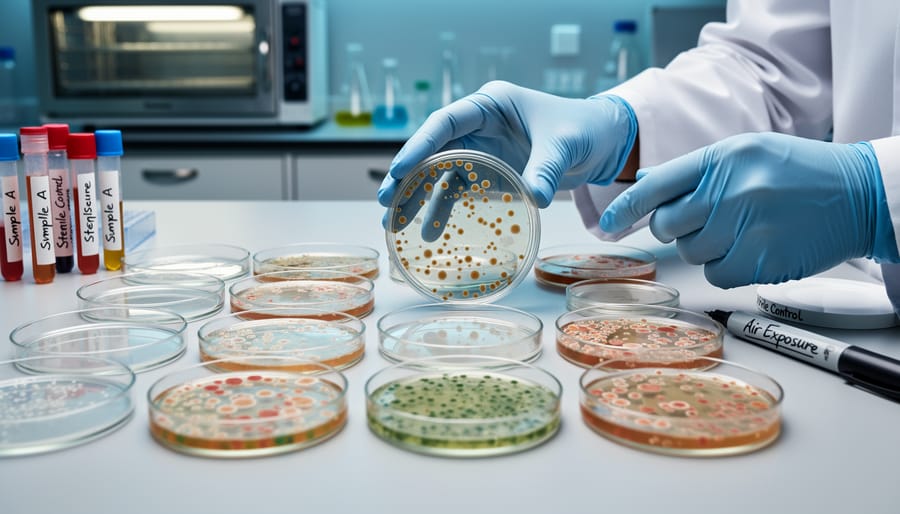
Sterility testing rests on a simple idea: if living microorganisms are present in a sample, give them food, warmth, and time, and watch for growth. If nothing grows after a defined period, we gain confidence that the material is free of viable contaminants. Notice the wording, though. It is confidence, not certainty, and that distinction deserves the same habit of questioning evidence that we bring to any claim about what lies beneath the surface.
In practice, the sequence generally looks like this:
- Draw a representative sample from the batch under controlled, aseptic conditions, so the act of sampling doesn’t introduce contamination.
- Inoculate the sample into growth media, typically one medium suited to aerobic bacteria and fungi and another suited to anaerobes.
- Incubate the media at set temperatures for a defined period, often around fourteen days, since slow-growing organisms need time to show themselves.
- Inspect the containers at regular intervals for turbidity, clouding, or other visible signs of growth, comparing against positive and negative controls.
- Interpret the outcome against acceptance criteria, and investigate any growth to determine whether it came from the product or from the testing environment.
Here is where the limits become clear. A test can only examine a small portion of a batch. If contamination is patchy or sparse, a sample may simply miss it. Some organisms are also fussy and won’t grow in standard media at all. So a passing result is evidence that the batch met the criteria, not an absolute guarantee that every vial is free of microbes.
That is why testing alone is never the whole story. The real work of keeping a peptide sterile happens earlier, through aseptic processing and filtration. Manufacturers prepare solutions in cleanroom environments, with trained operators, controlled airflow, and sanitized equipment. Sterile filtration, usually through membranes with pores small enough to trap bacteria, removes microorganisms before the product is filled into its final container.
Think of it as layers of assurance. Good process design reduces the chance of contamination, and testing checks that those safeguards did their job. When you read a supplier’s documentation, a credible claim of sterility should point to both: how the material was made and how it was verified. Either one without the other tells only half the story.
Reading a Certificate of Analysis With Discernment
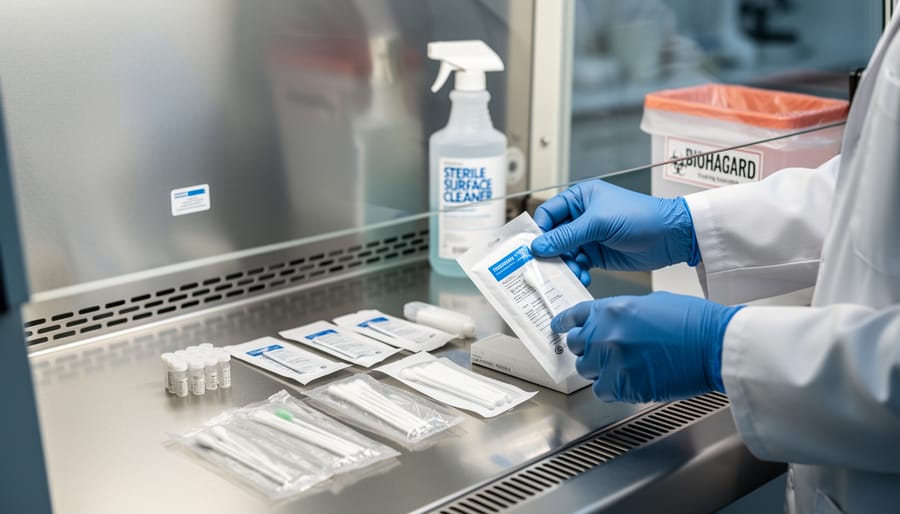
A Certificate of Analysis (COA) is the document that turns a supplier’s claim into something you can examine. It deserves the same patient attention we’d give any statement that asks for our trust.
Start with the endotoxin entry. A meaningful result states a number with units, usually endotoxin units per milligram (EU/mg) or per milliliter (EU/mL), and names the method used, such as a kinetic chromogenic LAL assay or a recombinant alternative. Look for a reference to the sample tested and, ideally, some sign that the assay was checked for interference. A line reading only “endotoxin: pass” tells you very little. Pass against what limit, and measured how?
The sterility entry works differently. It should name the method (for example, membrane filtration or direct inoculation), the growth media and incubation conditions, and the outcome, often “no growth observed.” Many research peptides are not sterility tested batch by batch at all. That isn’t automatically a flaw, but it should be stated honestly rather than implied away.
A few quiet signals are worth noticing:
– Missing batch or lot numbers, so the document can’t be tied to the vial you hold.
– No test date, or a date that predates the batch.
– Generic wording copied across different products.
– No lab name or contact information, whether in-house or third-party.
– Results that are suspiciously identical from lot to lot.
This is where independent verification matters. A COA from the manufacturer is a self-report, while a report from an accredited outside laboratory carries more weight because the tester has no stake in the outcome. A supplier who shares raw data, names their lab, and answers follow-up questions plainly is showing the transparency that builds real confidence.
None of this requires a scientific background, only the habit of asking what a statement actually shows and what it leaves unsaid. That habit of looking past the surface is the same discernment many of us bring to other areas of life. If you’ve reviewed COAs from suppliers in your own region, we’d love to hear what you’ve learned in the community forums.
Common Questions From the Community
Questions about purity tend to arrive from every direction, and that diversity is part of what makes this conversation valuable. Readers come to it as researchers, hobbyists, students and curious seekers, and each brings a different angle. Here are a few that come up often. We approach them in the same spirit as our philosophy of inclusion: no question is too basic, and no background is a barrier.
Can a sterile product still contain endotoxins?
Yes. Sterility means no living microorganisms remain, but endotoxins are fragments of bacterial cell walls that can persist after the bacteria themselves are gone. This is why the two tests answer separate questions.
Does “tested” mean “safe”?
Not by itself. A test result only tells you what was measured, by what method, and on which sample. Look for the actual result and the method behind it, not just the word “tested.”
Why do results vary between labs?
Differences in assay type, sample preparation, dilution and peptide interference can all shift readings. Sampling also matters, since one vial may not perfectly represent a whole batch.
Are endotoxin limits the same everywhere?
No. Limits depend on the intended use and the regulatory framework, and research-grade material often has no single universal threshold. That makes it worth asking what limit a supplier is measuring against.
If you want to go further, quality standards differ across regions, and people in different countries often see the same issue through very different regulatory and cultural lenses. We would love to hear what your corner of the world looks like. Bring your own questions, doubts and experiences to our community forums, where newcomers and seasoned voices learn side by side.
Discernment, in the end, is the habit of looking past the label to what is actually there. A peptide sold as research-grade deserves the same patient questioning we might bring to any bold claim, whether in a laboratory or a lecture hall. The reasoning behind karma and consequences offers a fitting parallel: what we put into the world, even invisibly, shapes what comes back, and a hidden contaminant in an experiment ripples outward into every conclusion drawn from it.
The practical lesson is simple to state. Sterility testing asks whether living microorganisms are present. Endotoxin testing asks whether the leftover fragments of bacterial cell walls remain, even when no living organism does. A product can pass one and fail the other, which is why a trustworthy certificate of analysis addresses both, names its methods, and shows its limits honestly. A passing result is evidence, not an absolute guarantee, and the best suppliers say so plainly.
That is why transparency matters so much. Clear documentation, validated methods, and shared international standards let researchers in Toronto, Nairobi, Mumbai, or São Paulo compare notes on equal footing. Truth that can be verified belongs to everyone who is willing to check it.
We would love to hear how this looks from where you stand. Have you read a certificate of analysis that left you puzzled, or seen testing practices that differ from region to region? Bring your questions, experiences, and traditions of inquiry to our community forums, and let’s keep seeking what is genuine, together.