
 melissa
 Greek contributions to philosophy represent the foundational frameworks of systematic thinking about existence, knowledge, ethics, and the nature of reality that continue to shape theosophical inquiry today. The ancient Greeks pioneered methods of rational investigation and contemplative wisdom that theosophists recognize as early expressions of perennial philosophy, the universal spiritual truths underlying all traditions.
When we explore Greek philosophical thought through a theosophical perspective, we discover far more than historical curiosity. These contributions established enduring questions about the soul’s journey, the structure of consciousness, and humanity’s relationship to the divine that remain central to contemporary spiritual practice. The Pythagorean emphasis on numerical harmony echoes through theosophical teachings on cosmic law. Platonic concepts of ideal forms and the soul’s ascent illuminate theosophical frameworks for spiritual evolution. Stoic practices of inner discipline mirror what theosophists call self-transformation through right living.
This article unpacks what the Greeks actually contributed to philosophical thought, how those contributions operate as living principles within theosophical understanding, which schools and thinkers proved most influential, and how you can apply these ancient insights to modern spiritual exploration. Whether you’re examining Paul through a theosophical lens or investigating Eastern wisdom traditions, Greek philosophy provides essential conceptual tools for navigating consciousness and cultivating wisdom.
The conversation between ancient Greek thought and theosophy isn’t one-directional. Theosophy draws from Greek sources while simultaneously revealing how those teachings connect to broader spiritual currents across cultures. This synthesis honors the Greek achievement while recognizing that truth transcends any single tradition. Understanding this relationship enriches both philosophical study and spiritual practice, offering pathways to deeper self-knowledge and universal wisdom.
What Greek Philosophy Means for Theosophy
Greek philosophy means for theosophy what a foundation means for a building: it supplies the conceptual architecture through which spiritual truths can be examined, debated, and understood. When ancient Greek thinkers began asking systematic questions about reality, knowledge, and virtue between the 6th and 3rd centuries BCE, they created intellectual tools that theosophy still uses today. These weren’t abstract exercises. The Greeks wanted to know how the universe works, what makes a life good, and whether we can trust what we think we know. Those same questions drive theosophical inquiry.
Three core domains define Greek philosophy’s gift to theosophy. Metaphysics explores the nature of reality itself, what exists beyond the physical world, how the cosmos is structured, and whether there are universal principles governing all things. Ethics examines how we should live, what virtues matter, and how individual conduct relates to universal harmony. Epistemology investigates the nature and limits of knowledge, how we distinguish truth from opinion, and whether humans can grasp ultimate reality. Each domain gave theosophy a language and method for spiritual investigation that complements insights from Eastern traditions and esoteric schools.
- Metaphysics
- The study of fundamental reality, including questions about being, existence, causation, and the structure of the cosmos beyond sensory experience.
- Ethics
- The branch of philosophy concerned with moral principles, virtuous living, and the relationship between individual actions and universal good.
- Epistemology
- The investigation of knowledge itself, how we know what we know, the difference between belief and certainty, and the reliability of human understanding.
- Dialectic
- A method of examining ideas through structured dialogue and questioning, used to reveal contradictions and move toward truth.
- Logos
- The Greek concept of rational principle or divine reason that orders the universe, later central to both Stoic philosophy and theosophical cosmology.
Understanding Greek thought matters for theosophists because it provides a shared grammar. When we discuss planes of existence, we’re building on Platonic models. When we apply ethical self-examination, we’re using Socratic techniques. When we analyze spiritual texts with a theosophical lens on Scripture we’re often employing methods refined by Aristotle’s core contributions to logic and systematic thought. Greek philosophy doesn’t replace other wisdom traditions within theosophy. It serves as a bridge, translating spiritual intuitions into frameworks that can be discussed, tested, and refined across cultures and centuries.
How Greek Philosophical Methods Shaped Theosophical Inquiry
The Socratic Method and Self-Knowledge
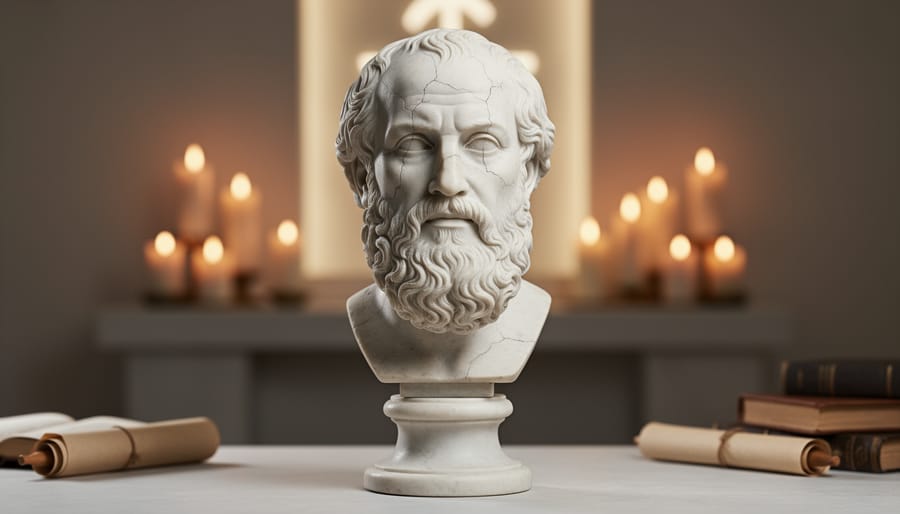
The Socratic method transforms abstract philosophical inquiry into a practical tool for spiritual development. Rather than lecturing students with ready-made answers, Socrates asked probing questions that forced individuals to examine their own beliefs, assumptions, and contradictions. This process of persistent questioning, “What do you mean by justice?” followed by “But doesn’t your definition fail in this case?”, strips away superficial understanding and pushes the seeker toward genuine self-knowledge.
Theosophy adopted this approach as a core practice because spiritual progress requires honest self-examination, not the passive absorption of doctrine. When theosophical study groups explore concepts like karma or universal brotherhood, they use Socratic questioning to challenge each participant’s understanding: “Do you truly believe in unity, or only when it’s convenient?” The Delphic maxim “know thyself” which Socrates championed, became theosophy’s starting point for inner development. You can’t transcend illusion or refine your character until you see yourself clearly, your biases, your motives, the gap between what you profess and how you live. This method doesn’t deliver comfort; it delivers clarity, which theosophists consider the foundation for real spiritual work.
Platonic Idealism and the Search for Truth
Plato’s theory of Forms proposed that the physical world we perceive is merely a shadow of a higher, eternal realm where perfect archetypes exist. This idea resonated deeply with theosophical founders, who saw in it a philosophical explanation for their concept of higher planes of existence. When Blavatsky wrote of spiritual hierarchies and divine prototypes, she drew directly on Platonic thought, adapting Plato’s Forms and Demiurge to describe how spiritual realities manifest in denser material forms.
For theosophists, the Form of the Good became analogous to the divine source from which all emanates. Plato’s insistence that true knowledge comes not through the senses but through contemplation of eternal truths validated theosophy’s emphasis on inner vision and meditation. His famous cave allegory, where prisoners mistake shadows for reality, mirrors the theosophical teaching that most humans live unaware of the spiritual dimensions surrounding them.
This Platonic framework gave theosophy a structured way to talk about spiritual evolution, the soul’s journey from material illusion toward recognition of transcendent reality. It wasn’t borrowing so much as recognizing a kindred spirit across millennia.
Aristotelian Logic and Systematic Thinking
Aristotle gave us the syllogism, a method of reasoning where two premises lead to a conclusion, and a systematic way to categorize knowledge. His logical framework became a tool theosophists use to organize complex spiritual concepts and test the coherence of metaphysical claims. When exploring ideas about karma or the structure of consciousness, theosophical writers often apply Aristotelian categories to clarify distinctions and relationships. This logical discipline doesn’t diminish spiritual insight; rather, it provides scaffolding that prevents vague mysticism from collapsing into confusion. By insisting that spiritual truths must withstand rational scrutiny, Aristotle’s influence helps theosophy maintain intellectual rigor while exploring dimensions beyond ordinary perception. His emphasis on observation and classification also encouraged theosophists to study spiritual phenomena systematically rather than relying solely on revelation.
Major Schools and Thinkers: Components of Greek Philosophy in Theosophy
Pre-Socratic Cosmology and Universal Principles

The earliest Greek philosophers turned their gaze to the cosmos itself, asking questions about the fundamental nature of reality that would echo through theosophical thought centuries later. Pythagoras taught that numbers governed the universe and that the soul transmigrated through successive lives, a doctrine of reincarnation strikingly similar to theosophical karma and rebirth. His concept of cosmic harmony, where mathematical ratios underpin all existence, prefigured theosophy’s vision of an ordered, interconnected universe.
Heraclitus introduced the principle of constant flux, his famous declaration that you cannot step in the same river twice capturing the impermanence theosophy later described as maya. His concept of the Logos, a divine reason permeating all things, became foundational to understanding universal law in theosophical terms.
Empedocles proposed that reality consists of four root elements held in balance by Love and Strife, cosmic forces driving cycles of unity and separation. His understanding of these cyclical patterns mirrors theosophical teachings about cosmic rounds and evolutionary spirals. These pre-Socratic thinkers gave theosophy a vocabulary for discussing universal principles, the soul’s journey, and the rhythmic patterns governing manifestation.
The Stoics: Ethics and Universal Brotherhood
The Stoics approached philosophy as a lived practice, not mere intellectual exercise. They taught that reason, what they called the logospervades the universe and connects all beings in a rational, moral order. This cosmic rationality meant that every human, regardless of birth or status, shared in the same divine spark. Their cosmopolitanism rejected tribal divisions and declared all people citizens of one universal community.
Epictetus, a former slave, and Marcus Aurelius, an emperor, both emphasized self-mastery and treating others with dignity as fundamental duties. Living according to nature meant aligning personal conduct with universal reason, cultivating virtue over external success. This ethical framework resonates deeply with theosophical teachings. The Stoic vision of a single human family practicing universal brotherhood in practice through rational compassion directly informed theosophy’s first fundamental principle. Their insistence that ethical living flows from recognizing our shared essence remains central to theosophical communities today.
Neoplatonism and Mystical Union
Plotinus, the third-century philosopher who founded Neoplatonism, gave theosophy one of its most enduring metaphysical frameworks. His vision centered on the One, an ineffable, ultimate reality from which all existence flows in descending levels of being. This process, called emanation, doesn’t diminish the source. Instead, reality cascades from pure unity into Nous (divine mind), then World Soul, and finally into the material realm we inhabit.
What made Plotinus revolutionary was his insistence that this outward flow could reverse. The soul, he taught, retains its connection to higher realities and can ascend back through contemplation and purification. This return journey, what later theosophists would call the Path, requires shedding identification with the material self and awakening to our divine origin.
Theosophy absorbed these ideas wholesale. Blavatsky’s concept of involution and evolution mirrors Plotinian emanation. The notion that consciousness descends into matter only to rise again, enriched by experience, comes directly from Neoplatonic teaching. When theosophists speak of the Higher Self or describe meditation as a practice of union with universal consciousness, they’re walking paths Plotinus mapped seventeen centuries ago.
Neoplatonism gave theosophy its vocabulary for mystical experience, a grammar of transcendence that bridges philosophy and direct spiritual encounter.
The Mystery Schools and Esoteric Tradition
The Eleusinian and Orphic mysteries represented Greek philosophy’s esoteric dimension, where spiritual truths weren’t merely discussed but experienced through sacred rituals and initiations. These mystery schools taught that genuine wisdom required inner transformation, a concept theosophy absorbed wholesale. The Eleusinian rites emphasized cycles of death and rebirth, while Orphic teachings explored the soul’s divine origin trapped in matter. Both traditions maintained that hidden knowledge couldn’t be transmitted through texts alone but required direct initiation under guidance. This model profoundly shaped theosophy’s approach to spiritual development, where intellectual study serves as preparation for deeper experiential understanding. The mystery schools demonstrated that philosophy becomes truly transformative only when it engages the whole being, not just the intellect.
How These Contributions Are Applied in Theosophical Study Today
Study Group Practices and Philosophical Dialogue
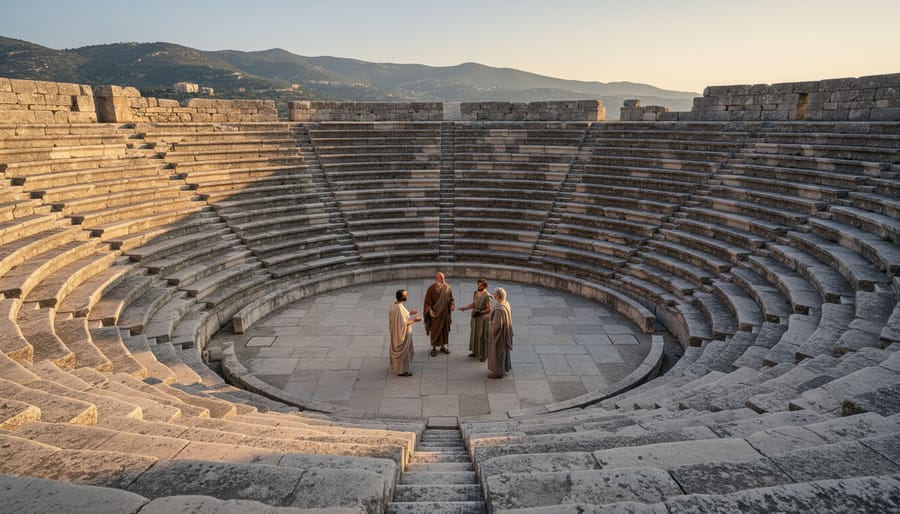
Study groups across theosophical communities worldwide have revitalized Greek dialectical methods as core practices. Rather than passive lecture formats, these circles emulate the Socratic elenchus, structured questioning that tests assumptions and draws out deeper understanding through collaborative inquiry. A typical session might begin with a participant posing a question about universal brotherhood or karma, then the group systematically examines definitions, identifies contradictions, and refines their collective thinking through respectful challenge and response.
Many circles integrate contemplative reading practice, approaching Platonic dialogues or Neoplatonic texts slowly and meditatively, pausing to absorb ideas rather than rushing through content. This method treats philosophical texts as living documents for inner transformation, not merely academic material. Participants often read passages aloud, then sit in silence before discussing implications for personal development.
The Greek influence extends to conversation structure itself: groups deliberately avoid dogmatic pronouncements, instead embracing aporia, comfortable uncertainty that keeps inquiry open. This creates spaces where members from diverse cultural backgrounds contribute perspectives, demonstrating how ancient Hellenic dialogue methods naturally support theosophy’s commitment to global wisdom synthesis and community-driven exploration.
Personal Development Through Ancient Wisdom
Greek philosophical practices offer theosophical students concrete tools for inner transformation that remain remarkably relevant today. Many practitioners begin with meditation on universal principles, contemplating concepts like Plato’s Good or the Stoic Logos, using these abstract ideas as focal points to shift awareness beyond mundane concerns toward timeless truths. This mirrors the Greek practice of theoria, sustained contemplation that elevates consciousness.
Ethical self-examination, drawn directly from the Socratic tradition, forms another pillar. Keeping a daily journal to question your motivations, challenge assumptions, and assess actions against universal ethical standards creates the honest self-knowledge that both Socrates and theosophy consider essential for spiritual progress. The Stoic evening review, asking “Where did I go wrong? What did I do? What duty left undone?”, provides a practical framework still used in theosophical circles.
The pursuit of gnosis through study completes the triad. Reading primary texts from Plotinus, Marcus Aurelius, or the Presocratics with contemplative attention, not just intellectual analysis, gradually unveils deeper meanings. This approach treats philosophy as spiritual practice rather than academic exercise, transforming ancient wisdom into living insight that reshapes how you understand yourself and reality.
Cross-Cultural Synthesis in Modern Theosophy

Theosophical thought thrives on cross-pollination, and Greek philosophical concepts don’t stand alone, they intersect with Buddhist notions of impermanence, Vedantic ideas of universal consciousness, and indigenous wisdom traditions to create a richer understanding. When a student reads Plato’s theory of Forms alongside the Upanishads’ Brahman, both illuminate the other: the Greek emphasis on rational inquiry balances Eastern contemplative approaches, while Eastern emphasis on direct experience grounds Greek abstract thought. Modern theosophical study groups routinely pair Stoic ethics with Buddhist compassion practices or compare Neoplatonic emanation with Hindu cosmology. This synthesis honors the theosophical principle that truth emerges from multiple cultural lenses working together, not from privileging one tradition. Greek contributions provide logical structure and dialectical rigor that help organize insights from diverse spiritual systems into a coherent framework for personal growth and collective understanding.
Common Questions About Greek Philosophy in Theosophy
Many people exploring theosophy wonder how ancient Greek ideas fit into a spiritual movement that draws from Eastern traditions and universal wisdom. These questions come up regularly in study groups and forums, so let’s address the most common points of confusion.
Did theosophy simply copy Greek philosophy?
No, theosophy synthesizes Greek thought with Eastern wisdom traditions, Western esotericism, and scientific inquiry rather than copying any single source. Greek contributions provide one vital thread in a much larger tapestry of global philosophical insight.
Why focus on Greek philosophy when theosophy emphasizes Eastern teachings?
Greek philosophy offers the Western intellectual framework many students use to approach universal truths, making Eastern concepts more accessible through familiar terminology and methods. The synthesis enriches both traditions without elevating one over the other.
Were Greek philosophers aware of Eastern ideas?
Historical evidence suggests some cross-pollination, especially through Pythagoras and later Neoplatonists who may have encountered Eastern thought through trade routes and the campaigns of Alexander the Great. However, Greek thinkers developed their systems largely independently, which makes the parallels with theosophical and Eastern ideas all the more striking.
Can I study theosophy without knowing Greek philosophy?
Absolutely, though understanding Greek contributions deepens your grasp of how theosophical concepts evolved and how Western seekers have historically engaged with universal wisdom. Many students start with theosophical texts and explore Greek roots later as their interest grows.
Another frequent concern involves whether the Greek emphasis on reason conflicts with theosophical spirituality. The two actually complement each other beautifully. Greek philosophers, particularly the Neoplatonists, never separated intellectual inquiry from spiritual experience. They viewed reason as a tool for ascending toward divine truth, not as a replacement for direct mystical encounter. This integration mirrors theosophy’s own balance between rigorous study and contemplative practice.
Some newcomers also ask whether Greek philosophy is too elitist or exclusive for a movement emphasizing universal brotherhood. It’s true that ancient Greece had social hierarchies we rightly reject today. Yet the philosophical ideas themselves, especially Stoic cosmopolitanism and the mystery school teachings about the divine spark in every human, directly support egalitarian spiritual principles. We take the wisdom while leaving behind outdated social structures, just as we do with all historical traditions.
How Greek Contributions to Philosophy Works
The Greek philosophical contribution works as a living transmission system rather than a fixed body of doctrine. Ancient Greek thinkers developed a method of inquiry that moves from questioning accepted beliefs to examining underlying assumptions, then synthesizing insights into coherent frameworks that can be tested through lived experience.
This process begins with dialectical exchange, the back-and-forth questioning that exposes contradictions and clarifies concepts. When you engage in theosophical study using this Greek-inspired approach, you start not with accepting teachings wholesale but with examining them through reasoned discussion. This path of gnosis through dialogue creates understanding that goes deeper than mere intellectual agreement.
The mechanism continues through contemplation, where you take the insights gained from discussion and reflect on them inwardly, testing them against personal experience and intuition. Greek philosophers insisted that genuine knowledge required both rational analysis and direct perception of truth, a dual approach theosophy inherited intact.
Finally, the process culminates in synthesis, where seemingly disparate ideas are woven into a unified vision of reality. This is how Plato moved from questioning what justice means to articulating an entire metaphysical system, and how theosophists use Greek philosophical tools to integrate wisdom from multiple traditions into a coherent spiritual worldview that remains open to further refinement.
The philosophical frameworks developed in ancient Greece continue to shape how we approach theosophical questions today. When you explore concepts like universal brotherhood, the nature of consciousness, or the path to spiritual awakening, you’re walking trails first cleared by Socrates, Plato, and their successors. These aren’t just historical footnotes, they’re living tools that help us think more clearly about reality’s deeper dimensions.
What makes Greek contributions especially valuable is their emphasis on rigorous questioning and systematic exploration. Theosophy doesn’t ask you to accept ideas blindly, and neither did the Greeks. They taught us to examine our assumptions, trace ideas to their logical conclusions, and remain open to wisdom from multiple sources. That spirit of inquiry bridges ancient Athens and modern theosophical communities around the world.
You don’t need to become a philosophy scholar to benefit from these insights. Start where you feel drawn, whether that’s contemplating Platonic ideals during meditation, applying Stoic ethics to daily challenges, or discussing Neoplatonic mysticism with fellow seekers. The beauty of this synthesis is that it welcomes diverse perspectives and personal interpretations.
We invite you to join ongoing conversations in our community forums, where members from various cultural backgrounds share how Greek philosophical concepts inform their spiritual practice. These dialogues often reveal connections and applications that solitary study might miss. Your questions and experiences add to our collective understanding of how ancient wisdom continues to illuminate the theosophical path.